Solve the right triangle shown in the figure. Round lengths to two decimal places and express angles to the nearest tenth of a degree. A = 23.5°, b = 10
Verified step by step guidance
1
Identify the given information: angle \(A = 23.5^\circ\) and side \(b = 10\). From the figure, angle \(A\) corresponds to angle \(Q\), and side \(b\) corresponds to side \(p\) (opposite angle \(Q\)).
Since the triangle is right-angled at \(R\), angle \(P\) can be found using the fact that the sum of angles in a triangle is \(180^\circ\). So, calculate angle \(P\) as \(90^\circ - 23.5^\circ\).
Use the sine function to find the hypotenuse \(r\) because \(\sin(\text{angle}) = \frac{\text{opposite}}{\text{hypotenuse}}\). Here, \(\sin(23.5^\circ) = \frac{p}{r}\), so rearrange to find \(r = \frac{p}{\sin(23.5^\circ)}\).
Use the cosine function to find side \(q\) (adjacent to angle \(Q\)) because \(\cos(\text{angle}) = \frac{\text{adjacent}}{\text{hypotenuse}}\). So, \(\cos(23.5^\circ) = \frac{q}{r}\), and rearranged \(q = r \times \cos(23.5^\circ)\).
Calculate all values using the above formulas, rounding lengths to two decimal places and angles to the nearest tenth of a degree as required.
Verified video answer for a similar problem:
This video solution was recommended by our tutors as helpful for the problem above
Video duration:
6m
Play a video:
0 Comments
Key Concepts
Here are the essential concepts you must grasp in order to answer the question correctly.
Right Triangle Properties
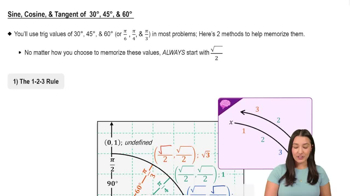
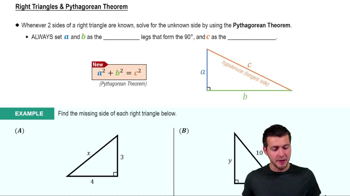
A right triangle has one angle of 90 degrees, and the sides are related by the Pythagorean theorem. The side opposite the right angle is the hypotenuse, the longest side, while the other two are legs. Understanding these properties helps in identifying which sides and angles to use in calculations.
Trigonometric ratios relate the angles of a right triangle to the ratios of its sides. Sine is opposite/hypotenuse, cosine is adjacent/hypotenuse, and tangent is opposite/adjacent. These ratios allow calculation of unknown sides or angles when some measurements are known.
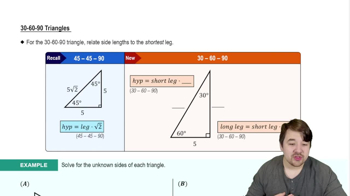
Knowing one acute angle and one side length in a right triangle allows determination of all other sides and angles. The sum of angles in a triangle is 180°, so the other acute angle can be found by subtracting the known angle and 90°. Then, trigonometric ratios can be applied to find missing sides.

 6:20 minutes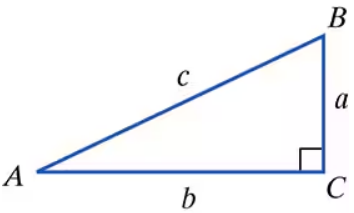
 Verified step by step guidance
 5:35
5:35