Starting at point X, a ship sails 15.5 km on a bearing of 200°, then turns and sails 2.4 km on a bearing of 320°. Find the distance of the ship from point X.
Table of contents
- 0. Review of College Algebra4h 45m
- 1. Measuring Angles40m
- 2. Trigonometric Functions on Right Triangles2h 5m
- 3. Unit Circle1h 19m
- 4. Graphing Trigonometric Functions1h 19m
- 5. Inverse Trigonometric Functions and Basic Trigonometric Equations1h 41m
- 6. Trigonometric Identities and More Equations2h 34m
- 7. Non-Right Triangles1h 38m
- 8. Vectors2h 25m
- 9. Polar Equations2h 5m
- 10. Parametric Equations1h 6m
- 11. Graphing Complex Numbers1h 7m
8. Vectors
Geometric Vectors
Problem 56
Textbook Question
A pilot is flying at 168 mph. She wants her flight path to be on a bearing of 57° 40′. A wind is blowing from the south at 27.1 mph. Find the bearing she should fly, and find the plane's ground speed.
Verified step by step guidance1
Identify the vectors involved: the plane's airspeed vector (unknown direction, magnitude 168 mph), and the wind vector (27.1 mph from the south, which means it blows towards the north). The resultant vector is the ground speed vector, which should have a bearing of 57° 40′.
Convert the bearing 57° 40′ into decimal degrees for easier calculation: 57 + 40/60 = 57.6667° approximately. This is the direction of the ground speed vector relative to north.
Set up a vector diagram where the plane's velocity vector plus the wind vector equals the ground velocity vector. Represent the plane's velocity vector as having magnitude 168 mph and an unknown bearing angle \( \theta \). The wind vector is 27.1 mph towards the north (bearing 0°).
Write the components of the vectors in terms of \( \theta \):
- Plane's velocity components: \( V_p = (168 \sin(\theta), 168 \cos(\theta)) \)
- Wind velocity components: \( V_w = (0, 27.1) \)
- Ground velocity components: \( V_g = (V_p^x + V_w^x, V_p^y + V_w^y) \)
Since the ground velocity has bearing 57.6667°, its components can be expressed as \( V_g = (V_g \sin(57.6667°), V_g \cos(57.6667°)) \), where \( V_g \) is the ground speed magnitude.
Set up equations equating the components:
\[
168 \sin(\theta) + 0 = V_g \sin(57.6667°) \\
168 \cos(\theta) + 27.1 = V_g \cos(57.6667°)
\]
Use these two equations to solve for \( \theta \) (the bearing the pilot should fly) and \( V_g \) (the ground speed).
Verified video answer for a similar problem:This video solution was recommended by our tutors as helpful for the problem above
Play a video:
0 Comments
Key Concepts
Here are the essential concepts you must grasp in order to answer the question correctly.
Vector Addition in Navigation
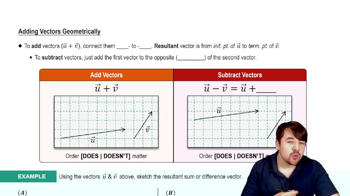
In navigation problems, the actual path of an aircraft is the vector sum of its velocity relative to the air and the wind velocity. Understanding how to add vectors graphically or analytically is essential to determine the resultant ground velocity and direction.
Recommended video:
Adding Vectors Geometrically
Bearing and Angle Measurement
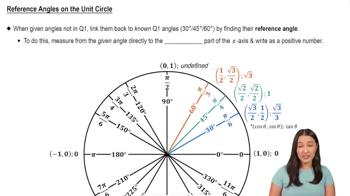
Bearing is a directional angle measured clockwise from the north line. Interpreting bearings correctly is crucial for setting and adjusting flight paths, as it defines the intended direction relative to geographic north.
Recommended video:
Reference Angles on the Unit Circle
Trigonometric Resolution of Vectors
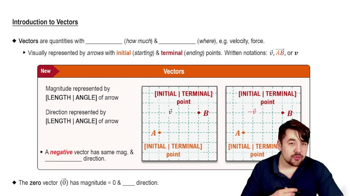
Resolving vectors into components using sine and cosine functions allows calculation of unknown directions and speeds. This involves breaking velocities into north-south and east-west components to solve for the plane's heading and ground speed.
Recommended video:
Introduction to Vectors
Related Videos
Related Practice
Textbook Question
767
views