Which of the following best describes supplementary angles?
Table of contents
- 0. Review of College Algebra4h 45m
- 1. Measuring Angles40m
- 2. Trigonometric Functions on Right Triangles2h 5m
- 3. Unit Circle1h 19m
- 4. Graphing Trigonometric Functions1h 19m
- 5. Inverse Trigonometric Functions and Basic Trigonometric Equations1h 41m
- 6. Trigonometric Identities and More Equations2h 34m
- 7. Non-Right Triangles1h 38m
- 8. Vectors2h 25m
- 9. Polar Equations2h 5m
- 10. Parametric Equations1h 6m
- 11. Graphing Complex Numbers1h 7m
1. Measuring Angles
Complementary and Supplementary Angles
Problem 18
Textbook Question
Find the measure of (a) the complement and (b) the supplement of an angle with the given measure. See Examples 1 and 3. 89°
Verified step by step guidance1
Understand the definitions: The complement of an angle is what, when added to the angle, equals 90°. The supplement of an angle is what, when added to the angle, equals 180°.
To find the complement of the given angle (89°), set up the equation: \(\text{complement} + 89^\circ = 90^\circ\).
Solve for the complement by subtracting 89° from 90°: \(\text{complement} = 90^\circ - 89^\circ\).
To find the supplement of the given angle (89°), set up the equation: \(\text{supplement} + 89^\circ = 180^\circ\).
Solve for the supplement by subtracting 89° from 180°: \(\text{supplement} = 180^\circ - 89^\circ\).
Verified video answer for a similar problem:This video solution was recommended by our tutors as helpful for the problem above
Video duration:
2mPlay a video:
0 Comments
Key Concepts
Here are the essential concepts you must grasp in order to answer the question correctly.
Complementary Angles
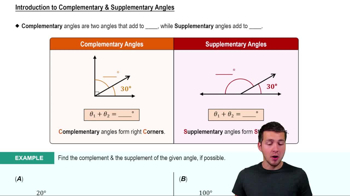
Complementary angles are two angles whose measures add up to 90 degrees. To find the complement of a given angle, subtract the angle's measure from 90°. For example, the complement of 30° is 60° because 30° + 60° = 90°.
Recommended video:
Intro to Complementary & Supplementary Angles
Supplementary Angles
Supplementary angles are two angles whose measures add up to 180 degrees. To find the supplement of a given angle, subtract the angle's measure from 180°. For instance, the supplement of 110° is 70° since 110° + 70° = 180°.
Recommended video:
Intro to Complementary & Supplementary Angles
Angle Measurement and Units
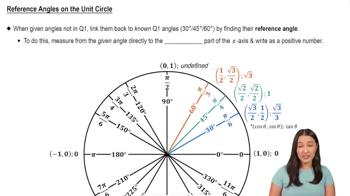
Angles are measured in degrees, representing the amount of rotation between two rays. Understanding how to interpret and manipulate angle measures is essential for solving problems involving complements and supplements, especially when working with degrees.
Recommended video:
Reference Angles on the Unit Circle
Related Videos
Related Practice
Multiple Choice
85
views