In Exercises 41–43, find the exact value of each of the remaining trigonometric functions of θ. cos θ = 2/5, sin θ < 0
Verified step by step guidance
1
Identify the given information: \(\cos \theta = \frac{2}{5}\) and \(\sin \theta < 0\). This tells us the cosine value and that the sine is negative, which helps determine the quadrant where \(\theta\) lies.
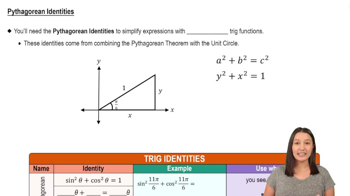
Recall the Pythagorean identity: \(\sin^{2} \theta + \cos^{2} \theta = 1\). Use this to find \(\sin \theta\) by substituting \(\cos \theta = \frac{2}{5}\) into the equation.
Since \(\sin \theta < 0\), choose the negative value: \(\sin \theta = -\frac{\sqrt{21}}{5}\).
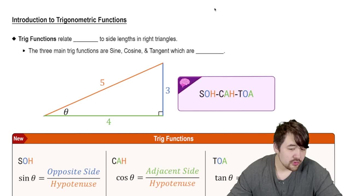
Find the remaining trigonometric functions using the definitions: \(\tan \theta = \frac{\sin \theta}{\cos \theta}\), \(\csc \theta = \frac{1}{\sin \theta}\), \(\sec \theta = \frac{1}{\cos \theta}\), and \(\cot \theta = \frac{1}{\tan \theta}\). Substitute the values of \(\sin \theta\) and \(\cos \theta\) to express each function exactly.
Verified video answer for a similar problem:
This video solution was recommended by our tutors as helpful for the problem above
Video duration:
8m
Play a video:
0 Comments
Key Concepts
Here are the essential concepts you must grasp in order to answer the question correctly.
Pythagorean Identity
The Pythagorean identity states that sin²θ + cos²θ = 1 for any angle θ. Given cos θ, this identity allows you to find sin θ by rearranging the equation. Since cos θ = 2/5, you can calculate sin θ as ±√(1 - (2/5)²), choosing the sign based on the given condition.
The sign of sine and cosine depends on the quadrant where the angle θ lies. Since sin θ < 0 and cos θ = 2/5 (positive), θ must be in the fourth quadrant, where cosine is positive and sine is negative. This helps determine the correct sign for sin θ and other functions.
Trigonometric functions such as tangent, cotangent, secant, and cosecant are defined in terms of sine and cosine. For example, tan θ = sin θ / cos θ, sec θ = 1 / cos θ, etc. Once sin θ and cos θ are known, these remaining functions can be calculated exactly.

 8:40 minutes
 Verified step by step guidance
 6:25
6:25