In the following exercises, (a) find the center-radius form of the equation of each circle described, and (b) graph it. See Examples 5 and 6. center (√2, √2), radius √2
Table of contents
- 0. Review of College Algebra4h 45m
- 1. Measuring Angles40m
- 2. Trigonometric Functions on Right Triangles2h 5m
- 3. Unit Circle1h 19m
- 4. Graphing Trigonometric Functions1h 19m
- 5. Inverse Trigonometric Functions and Basic Trigonometric Equations1h 41m
- 6. Trigonometric Identities and More Equations2h 34m
- 7. Non-Right Triangles1h 38m
- 8. Vectors2h 25m
- 9. Polar Equations2h 5m
- 10. Parametric Equations1h 6m
- 11. Graphing Complex Numbers1h 7m
0. Review of College Algebra
Basics of Graphing
Problem 63
Textbook Question
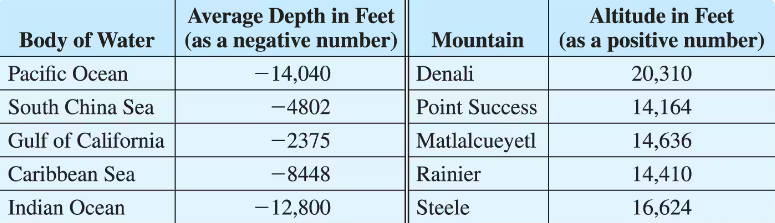
Sea level refers to the surface of the ocean. The depth of a body of water can be expressed as a negative number, representing average depth in feet below sea level. The altitude of a mountain can be expressed as a positive number, indicating its height in feet above sea level. The table gives selected depths and altitudes. List the bodies of water in order, deepest to shallowest.

Verified step by step guidance1
Identify the depths of the bodies of water from the table, noting that depths are given as negative numbers representing feet below sea level.
Recall that a more negative number indicates a greater depth below sea level, so the body of water with the largest negative value is the deepest.
List all the bodies of water by their depth values, from the most negative (deepest) to the least negative (shallowest).
Ignore any positive numbers in the table, as those represent altitudes above sea level, not depths.
Arrange the bodies of water in order from the largest negative depth to the smallest negative depth to complete the list from deepest to shallowest.
Verified video answer for a similar problem:This video solution was recommended by our tutors as helpful for the problem above
Video duration:
3mPlay a video:
0 Comments
Key Concepts
Here are the essential concepts you must grasp in order to answer the question correctly.
Understanding Sea Level as a Reference Point
Sea level is the baseline or zero point used to measure elevation and depth. Positive values indicate heights above sea level (altitudes), while negative values represent depths below sea level. This reference allows consistent comparison of elevations and depths.
Recommended video:
Reference Angles on the Unit Circle
Interpreting Negative and Positive Values
Depths below sea level are expressed as negative numbers, indicating how far below the surface a point lies. Altitudes above sea level are positive numbers. Recognizing this sign convention is essential for correctly ordering depths from deepest (most negative) to shallowest (closest to zero).
Recommended video:
Drawing Angles in Standard Position
Ordering Numerical Values on the Number Line
To list bodies of water from deepest to shallowest, one must order their depth values from the smallest (most negative) to the largest (least negative or zero). Understanding how to compare negative numbers on the number line is crucial for accurate ranking.
Recommended video:
Sine, Cosine, & Tangent of 30°, 45°, & 60°
Related Videos
Related Practice
Textbook Question
353
views