In Exercises 39–42, let u = -i + j, v = 3i - 2j, and w = -5j. Find each specified scalar or vector. 5u ⋅ (3v - 4w)
Verified step by step guidance
1
First, express the vectors u, v, and w in component form: \( u = \langle -1, 1 \rangle \), \( v = \langle 3, -2 \rangle \), and \( w = \langle 0, -5 \rangle \).
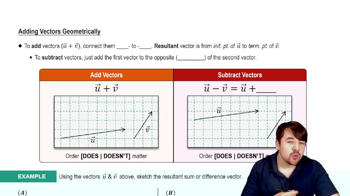
Calculate the vector inside the parentheses: \( 3v - 4w \). Multiply each vector by the scalar and then subtract: \( 3v = 3 \times \langle 3, -2 \rangle = \langle 9, -6 \rangle \) and \( 4w = 4 \times \langle 0, -5 \rangle = \langle 0, -20 \rangle \). Then, \( 3v - 4w = \langle 9, -6 \rangle - \langle 0, -20 \rangle \).
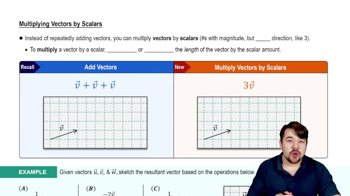
Multiply the vector u by the scalar 5: \( 5u = 5 \times \langle -1, 1 \rangle = \langle -5, 5 \rangle \).
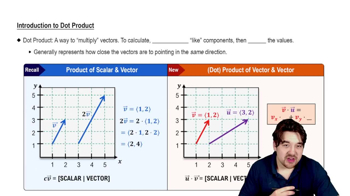
Finally, compute the dot product of \( 5u \) and \( 3v - 4w \): \( \langle -5, 5 \rangle \cdot \langle 9, 14 \rangle = (-5)(9) + (5)(14) \).
Verified video answer for a similar problem:
This video solution was recommended by our tutors as helpful for the problem above
Video duration:
3m
Play a video:
0 Comments
Key Concepts
Here are the essential concepts you must grasp in order to answer the question correctly.
Vector Scalar Multiplication
Scalar multiplication involves multiplying each component of a vector by a scalar (a real number). This operation changes the magnitude of the vector without altering its direction unless the scalar is negative, which reverses the direction.
Vector addition and subtraction are performed component-wise. To add or subtract vectors, add or subtract their corresponding components, resulting in a new vector that combines the effects of the original vectors.
The dot product is a scalar obtained by multiplying corresponding components of two vectors and summing the results. It measures the extent to which two vectors point in the same direction and is calculated as u ⋅ v = u₁v₁ + u₂v₂ for 2D vectors.