Fill in the blank(s) to correctly complete each sentence. The graph of y = -3 sin x is obtained by stretching the graph of y = sin x by a factor of ________ and reflecting across the ________-axis.
Verified step by step guidance
1
Identify the general form of the sine function transformation: \(y = A \sin x\), where \(A\) represents the amplitude, which affects the vertical stretch or compression of the graph.
Compare the given function \(y = -3 \sin x\) with the basic sine function \(y = \sin x\). Notice that the amplitude changes from 1 to 3, indicating a vertical stretch by a factor of 3.
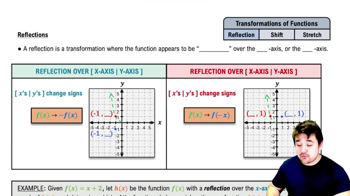
Observe the negative sign in front of the amplitude, which means the graph is reflected across the x-axis.
Summarize the transformation: the graph is stretched vertically by a factor of 3 and reflected across the x-axis.
Fill in the blanks accordingly: The graph of \(y = -3 \sin x\) is obtained by stretching the graph of \(y = \sin x\) by a factor of 3 and reflecting across the x-axis.
Verified video answer for a similar problem:
This video solution was recommended by our tutors as helpful for the problem above
Play a video:
0 Comments
Key Concepts
Here are the essential concepts you must grasp in order to answer the question correctly.
Amplitude and Vertical Stretching
The amplitude of a sine function is the absolute value of the coefficient before sin x, which determines the vertical stretch or compression. For y = -3 sin x, the amplitude is 3, meaning the graph is stretched vertically by a factor of 3 compared to y = sin x.
A negative coefficient before the sine function indicates a reflection of the graph across the x-axis. This flips the graph upside down, changing the direction of the peaks and troughs while preserving the shape.
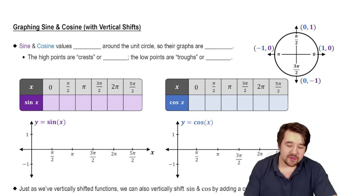
The graph of y = sin x is a periodic wave oscillating between -1 and 1 with a period of 2π. Understanding this baseline graph is essential to recognize how transformations like stretching and reflection affect its shape.

 Verified step by step guidance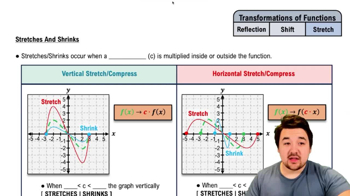
 6:02
6:02