In Exercises 1–12, solve each triangle. Round lengths to the nearest tenth and angle measures to the nearest degree. If no triangle exists, state 'no triangle.' If two triangles exist, solve each triangle.A = 162°, b = 11.2, c = 48.2
Verified step by step guidance
1
Identify the given information: angle \(A = 162^\circ\), side \(b = 11.2\), and side \(c = 48.2\).
Use the Law of Sines to find another angle. The Law of Sines states: \(\frac{a}{\sin A} = \frac{b}{\sin B} = \frac{c}{\sin C}\). Start by finding angle \(B\) using \(\frac{b}{\sin B} = \frac{c}{\sin C}\).
Rearrange the equation to solve for \(\sin B\): \(\sin B = \frac{b \cdot \sin A}{c}\).
Calculate \(\sin B\) using the values: \(b = 11.2\), \(A = 162^\circ\), and \(c = 48.2\).
Determine angle \(B\) by taking the inverse sine of the calculated \(\sin B\). Check if the calculated angle \(B\) is valid, considering the sum of angles in a triangle should be \(180^\circ\).
Verified video answer for a similar problem:
This video solution was recommended by our tutors as helpful for the problem above
Video duration:
7m
Play a video:
0 Comments
Key Concepts
Here are the essential concepts you must grasp in order to answer the question correctly.
Law of Sines
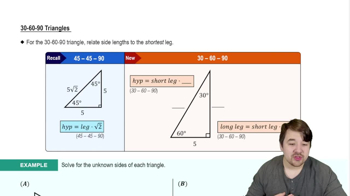
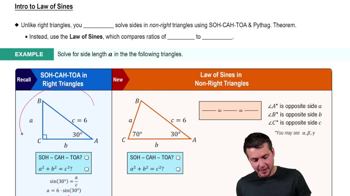
The Law of Sines is a fundamental principle in trigonometry that relates the ratios of the lengths of sides of a triangle to the sines of its angles. It states that for any triangle, the ratio of a side length to the sine of its opposite angle is constant. This law is particularly useful for solving triangles when given two angles and one side (AAS or ASA) or two sides and a non-included angle (SSA).
To determine if a triangle can exist with given side lengths and angles, one must consider the triangle inequality theorem and the conditions for angle measures. Specifically, the sum of the angles in a triangle must equal 180°, and the lengths of any two sides must be greater than the length of the third side. If these conditions are not met, it may result in 'no triangle' or the possibility of two distinct triangles.
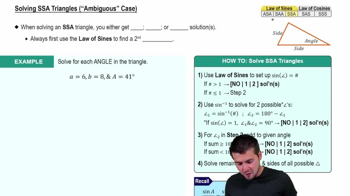
The ambiguous case of SSA (Side-Side-Angle) occurs when two sides and a non-included angle are known, leading to the possibility of zero, one, or two triangles. This situation arises because the given angle may correspond to two different configurations of the triangle. To resolve this, one must analyze the given measurements to determine if one triangle, two triangles, or no triangle can be formed based on the angle and side lengths provided.