Table of contents
- 0. Review of College Algebra4h 45m
- 1. Measuring Angles40m
- 2. Trigonometric Functions on Right Triangles2h 5m
- 3. Unit Circle1h 19m
- 4. Graphing Trigonometric Functions1h 19m
- 5. Inverse Trigonometric Functions and Basic Trigonometric Equations1h 41m
- 6. Trigonometric Identities and More Equations2h 34m
- 7. Non-Right Triangles1h 38m
- 8. Vectors2h 25m
- 9. Polar Equations2h 5m
- 10. Parametric Equations1h 6m
- 11. Graphing Complex Numbers1h 7m
3. Unit Circle
Trigonometric Functions on the Unit Circle
Problem 23
Textbook Question
In Exercises 19–24, a. Use the unit circle shown for Exercises 5–18 to find the value of the trigonometric function.b. Use even and odd properties of trigonometric functions and your answer from part (a) to find the value of the same trigonometric function at the indicated real number.tan 5𝜋/3
Verified step by step guidance1
Identify the angle 5\(\pi\)/3 on the unit circle. Notice that 5\(\pi\)/3 is equivalent to 2\(\pi\) - \(\pi\)/3, which places it in the fourth quadrant.
Locate the coordinates on the unit circle for the angle \(\pi\)/3, which are (1/2, \(\sqrt{3}\)/2).
Since 5\(\pi\)/3 is in the fourth quadrant, the coordinates are (1/2, -\(\sqrt{3}\)/2) because the y-coordinate is negative in the fourth quadrant.
Recall that the tangent function is defined as \(\tan\)(\(\theta\)) = \(\frac{y}{x}\).
Substitute the coordinates (1/2, -\(\sqrt{3}\)/2) into the tangent function: \(\tan\)(5\(\pi\)/3) = \(\frac{-\sqrt{3}\)/2}{1/2}.
Verified video answer for a similar problem:This video solution was recommended by our tutors as helpful for the problem above
Video duration:
5mPlay a video:
0 Comments
Key Concepts
Here are the essential concepts you must grasp in order to answer the question correctly.
Unit Circle
The unit circle is a circle with a radius of one centered at the origin of a coordinate plane. It is fundamental in trigonometry as it provides a geometric representation of the sine, cosine, and tangent functions. The coordinates of points on the unit circle correspond to the cosine and sine values of angles measured from the positive x-axis, allowing for easy calculation of trigonometric functions.
Recommended video:
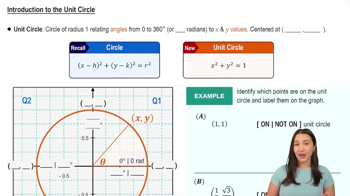
Introduction to the Unit Circle
Trigonometric Functions
Trigonometric functions, including sine, cosine, and tangent, relate the angles of a triangle to the lengths of its sides. In the context of the unit circle, these functions can be defined as follows: sine is the y-coordinate, cosine is the x-coordinate, and tangent is the ratio of sine to cosine. Understanding these functions is crucial for solving problems involving angles and their corresponding values.
Recommended video:
Introduction to Trigonometric Functions
Even and Odd Properties
Trigonometric functions exhibit specific symmetry properties: sine is an odd function (sin(-x) = -sin(x)), while cosine is an even function (cos(-x) = cos(x)). This means that the sine function reflects across the origin, while the cosine function reflects across the y-axis. These properties can simplify calculations and help find values of trigonometric functions at negative angles or angles greater than 2π.
Recommended video:
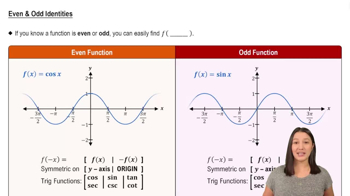
Even and Odd Identities
Related Videos
Related Practice
Textbook Question
In Exercises 5–18, the unit circle has been divided into twelve equal arcs, corresponding to t-values of0, 𝜋, 𝜋, 𝜋, 2𝜋, 5𝜋, 𝜋, 7𝜋, 4𝜋, 3𝜋, 5𝜋, 11𝜋, and 2𝜋.6 3 2 3 6 6 3 2 3 6Use the (x,y) coordinates in the figure to find the value of each trigonometric function at the indicated real number, t, or state that the expression is undefined.In Exercises 11–18, continue to refer to the figure at the bottom of the previous page.tan 3𝜋/2
1588
views