In Exercises 5–8, let v = -5i + 2j and w = 2i - 4j Find the specified vector, scalar, or angle. projᵥᵥv
Verified step by step guidance
1
Identify the vectors involved: here, both vectors are \( \mathbf{v} = -5\mathbf{i} + 2\mathbf{j} \) and \( \mathbf{w} = 2\mathbf{i} - 4\mathbf{j} \), but the problem asks for \( \text{proj}_{\mathbf{v}} \mathbf{v} \), which means the projection of \( \mathbf{v} \) onto itself.
Recall the formula for the projection of a vector \( \mathbf{a} \) onto a vector \( \mathbf{b} \):
\[ \text{proj}_{\mathbf{b}} \mathbf{a} = \left( \frac{\mathbf{a} \cdot \mathbf{b}}{\mathbf{b} \cdot \mathbf{b}} \right) \mathbf{b} \]
where \( \mathbf{a} \cdot \mathbf{b} \) is the dot product of \( \mathbf{a} \) and \( \mathbf{b} \).
Since we are projecting \( \mathbf{v} \) onto itself, substitute \( \mathbf{a} = \mathbf{v} \) and \( \mathbf{b} = \mathbf{v} \) into the formula:
\[ \text{proj}_{\mathbf{v}} \mathbf{v} = \left( \frac{\mathbf{v} \cdot \mathbf{v}}{\mathbf{v} \cdot \mathbf{v}} \right) \mathbf{v} \]
Calculate the dot product \( \mathbf{v} \cdot \mathbf{v} \) by multiplying corresponding components and summing:
\[ \mathbf{v} \cdot \mathbf{v} = (-5)(-5) + (2)(2) \]
Simplify the fraction \( \frac{\mathbf{v} \cdot \mathbf{v}}{\mathbf{v} \cdot \mathbf{v}} \) which will equal 1, so the projection \( \text{proj}_{\mathbf{v}} \mathbf{v} \) is simply \( \mathbf{v} \) itself.
Verified video answer for a similar problem:
This video solution was recommended by our tutors as helpful for the problem above
Video duration:
3m
Play a video:
0 Comments
Key Concepts
Here are the essential concepts you must grasp in order to answer the question correctly.
Vector Projection
Vector projection of one vector onto another is the component of the first vector in the direction of the second. It is found by scaling the second vector by the scalar projection, which involves the dot product divided by the magnitude squared of the second vector.
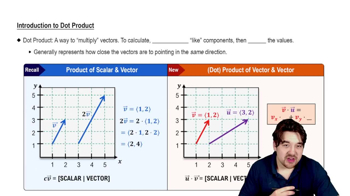
The dot product is an algebraic operation that takes two equal-length sequences of numbers (vectors) and returns a single number. It is calculated as the sum of the products of corresponding components and is used to find angles between vectors and projections.
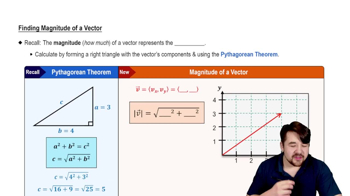
The magnitude (or length) of a vector is the distance from the origin to the point represented by the vector in space. It is calculated using the Pythagorean theorem as the square root of the sum of the squares of its components.

 3:22 minutes
 Verified step by step guidance
 03:48
03:48