Join thousands of students who trust us to help them ace their exams!
Multiple Choice
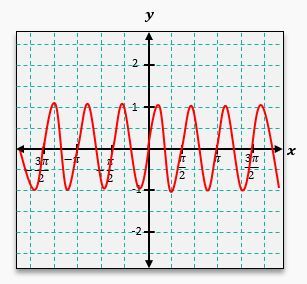
Given below is the graph of the function y=sin(bx). Determine the correct value for b.
A
b=π
B
b=2
C
b=21
D
b=4
0 Comments
Verified step by step guidance
1
First, identify the period of the function y = \(\sin\)(bx) from the graph. The period is the distance between two consecutive peaks or troughs.
Observe the graph and note that the function completes one full cycle between x = 0 and x = \(\frac{\pi}{2}\). This indicates that the period of the function is \(\frac{\pi}{2}\).
Recall the formula for the period of the sine function y = \(\sin\)(bx), which is given by \(\frac{2\pi}{b}\). Set this equal to the observed period: \(\frac{2\pi}{b}\) = \(\frac{\pi}{2}\).
Solve the equation \(\frac{2\pi}{b}\) = \(\frac{\pi}{2}\) for b. Start by cross-multiplying to get 2\(\pi\) = b \(\cdot\) \(\frac{\pi}{2}\).
Divide both sides by \(\pi\) to isolate b, resulting in b = 4.


 Verified step by step guidance

