Determine the signs of the trigonometric functions of an angle in standard position with the given measure. See Example 2. 84°
Table of contents
- 0. Review of College Algebra4h 45m
- 1. Measuring Angles40m
- 2. Trigonometric Functions on Right Triangles2h 5m
- 3. Unit Circle1h 19m
- 4. Graphing Trigonometric Functions1h 19m
- 5. Inverse Trigonometric Functions and Basic Trigonometric Equations1h 41m
- 6. Trigonometric Identities and More Equations2h 34m
- 7. Non-Right Triangles1h 38m
- 8. Vectors2h 25m
- 9. Polar Equations2h 5m
- 10. Parametric Equations1h 6m
- 11. Graphing Complex Numbers1h 7m
2. Trigonometric Functions on Right Triangles
Trigonometric Functions on Right Triangles
Problem 2.5.33
Textbook Question
Solve each problem. See Examples 3 and 4. Height of an Antenna A scanner antenna is on top of the center of a house. The angle of elevation from a point 28.0 m from the center of the house to the top of the antenna is 27°10', and the angle of elevation to the bottom of the antenna is 18°10'. Find the height of the antenna.
Verified step by step guidance1
Identify the points involved: the point on the ground 28.0 m from the house center, the bottom of the antenna (top of the house), and the top of the antenna. The horizontal distance from the observation point to the house center is 28.0 m.
Convert the given angles from degrees and minutes to decimal degrees or use them as is in trigonometric functions. For example, 27°10' means 27 degrees and 10 minutes, where 1 minute = 1/60 degrees.
Use the tangent function, which relates the angle of elevation to the opposite side (height) and adjacent side (horizontal distance). For the bottom of the antenna (top of the house), set up the equation: \(\tan(18^{\circ}10') = \frac{h_{house}}{28.0}\), where \(h_{house}\) is the height of the house.
Similarly, for the top of the antenna, set up the equation: \(\tan(27^{\circ}10') = \frac{h_{house} + h_{antenna}}{28.0}\), where \(h_{antenna}\) is the height of the antenna.
Solve the first equation for \(h_{house}\), then substitute into the second equation to solve for \(h_{house} + h_{antenna}\). Finally, subtract \(h_{house}\) from this result to find the height of the antenna: \(h_{antenna} = (h_{house} + h_{antenna}) - h_{house}\).
Verified video answer for a similar problem:This video solution was recommended by our tutors as helpful for the problem above
Play a video:
0 Comments
Key Concepts
Here are the essential concepts you must grasp in order to answer the question correctly.
Angle of Elevation
The angle of elevation is the angle formed between the horizontal line from the observer's eye and the line of sight to an object above the horizontal. It helps determine the height of objects by relating distances and angles in right triangles.
Recommended video:
Coterminal Angles
Right Triangle Trigonometry
Right triangle trigonometry uses sine, cosine, and tangent ratios to relate the angles and sides of right triangles. In this problem, tangent is used to connect the height of the antenna and the horizontal distance from the observer.
Recommended video:
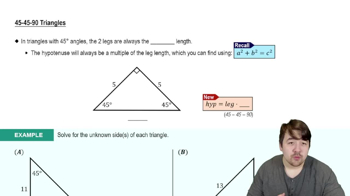
45-45-90 Triangles
Difference of Heights Using Angles
By calculating the heights corresponding to two different angles of elevation (top and bottom of the antenna) from the same horizontal distance, the height of the antenna is found by subtracting the lower height from the higher one.
Recommended video:
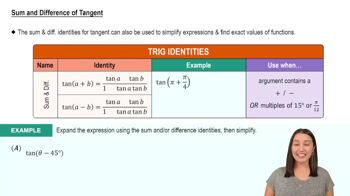
Sum and Difference of Tangent
Related Videos
Related Practice
Textbook Question
689
views