In Exercises 47–54, use the figures to find the exact value of each trigonometric function. cos(α/2)
Verified step by step guidance
1
Identify the given angle \( \alpha \) and the trigonometric function you need to find, which in this case is \( \cos \alpha \).
Recall the definition of cosine in a right triangle: \( \cos \alpha = \frac{\text{adjacent side}}{\text{hypotenuse}} \).
Examine the figure provided (usually a right triangle) to determine the lengths of the adjacent side and the hypotenuse relative to angle \( \alpha \).
Substitute the lengths of the adjacent side and hypotenuse into the cosine ratio formula: \( \cos \alpha = \frac{\text{adjacent}}{\text{hypotenuse}} \).
Simplify the fraction if possible to find the exact value of \( \cos \alpha \).
Verified video answer for a similar problem:
This video solution was recommended by our tutors as helpful for the problem above
Video duration:
4m
Play a video:
0 Comments
Key Concepts
Here are the essential concepts you must grasp in order to answer the question correctly.
Trigonometric Functions
Trigonometric functions like sine, cosine, and tangent relate the angles of a right triangle to the ratios of its sides. Understanding these functions is essential for finding exact values based on given angles or side lengths.
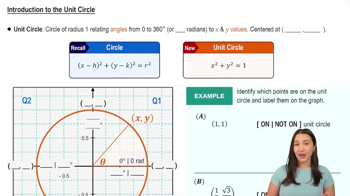
The unit circle represents angles and their corresponding trigonometric values on a circle of radius one. Knowing how to interpret angles in radians or degrees on the unit circle helps in determining exact trigonometric values.
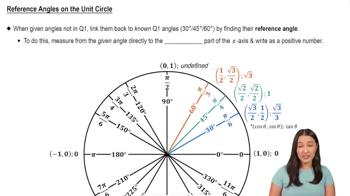
Reference angles are acute angles used to find trigonometric values for angles in different quadrants. Recognizing the quadrant of the angle helps determine the sign (positive or negative) of the trigonometric function.

 4:22 minutes
 Verified step by step guidance

 6:04
6:04