Suppose θ is in the interval (90°, 180°). Find the sign of each of the following. sin(-θ)
Verified step by step guidance
1
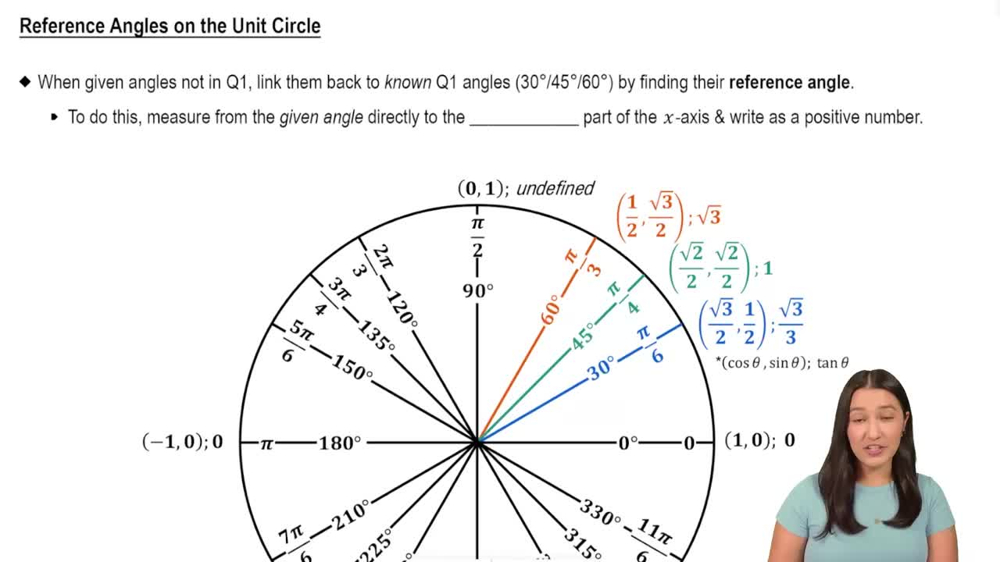
Recall the interval for \( \theta \) is \( (90^\circ, 180^\circ) \), which means \( \theta \) is in the second quadrant.
Understand that \( -\theta \) is the negative of an angle in the second quadrant, so \( -\theta \) lies in the interval \( (-180^\circ, -90^\circ) \), which corresponds to the third or fourth quadrant when considering standard position angles.
Use the odd function property of sine: \( \sin(-\theta) = -\sin(\theta) \). This means the sine of the negative angle is the negative of the sine of the positive angle.
Since \( \theta \) is in the second quadrant, \( \sin(\theta) \) is positive (because sine is positive in the second quadrant).
Therefore, \( \sin(-\theta) = -\sin(\theta) \) is negative, because it is the negative of a positive value.
Verified video answer for a similar problem:
This video solution was recommended by our tutors as helpful for the problem above
Play a video:
0 Comments
Key Concepts
Here are the essential concepts you must grasp in order to answer the question correctly.
Trigonometric Function Signs in Different Quadrants
The sign of trigonometric functions depends on the quadrant of the angle. For angles between 90° and 180° (second quadrant), sine is positive, cosine is negative, and tangent is negative. Understanding this helps determine the sign of functions involving angles in specific intervals.
Negative angle identities relate the trigonometric function of a negative angle to the function of the positive angle. For sine, sin(-θ) = -sin(θ), meaning the sine of a negative angle is the negative of the sine of the positive angle. This property is essential for evaluating sin(-θ).
Knowing the interval of θ helps identify the reference angle and the sign of the function. Since θ is in (90°, 180°), -θ lies in (-180°, -90°), which corresponds to the third or fourth quadrant in the negative direction. This helps determine the sign of sin(-θ) using quadrant rules.

 Verified step by step guidance
 6:04
6:04