Solve the right triangle shown in the figure. Round lengths to two decimal places and express angles to the nearest tenth of a degree. b = 2, c = 7
Table of contents
- 0. Review of College Algebra4h 45m
- 1. Measuring Angles40m
- 2. Trigonometric Functions on Right Triangles2h 5m
- 3. Unit Circle1h 19m
- 4. Graphing Trigonometric Functions1h 19m
- 5. Inverse Trigonometric Functions and Basic Trigonometric Equations1h 41m
- 6. Trigonometric Identities and More Equations2h 34m
- 7. Non-Right Triangles1h 38m
- 8. Vectors2h 25m
- 9. Polar Equations2h 5m
- 10. Parametric Equations1h 6m
- 11. Graphing Complex Numbers1h 7m
2. Trigonometric Functions on Right Triangles
Solving Right Triangles
Problem 35
Textbook Question
In Exercises 29–36, find the length x to the nearest whole unit.

Verified step by step guidance1
Identify the right triangle and the given information: one angle is 22°, the other non-right angle is 54°, the base adjacent to the 22° angle is 200 units, and the height (opposite side to the 54° angle) is x, which we need to find.
Recall that in a right triangle, the sum of the two non-right angles is 90°, which matches the given angles 22° and 54°, confirming the triangle's angle measures.
Use the tangent function for the 54° angle, since tangent relates the opposite side to the adjacent side: \(\tan(54^\circ) = \frac{x}{200}\).
Rearrange the equation to solve for x: \(x = 200 \times \tan(54^\circ)\).
Calculate the value of \(\tan(54^\circ)\) using a calculator, then multiply by 200 to find the length x, rounding to the nearest whole unit.
Verified video answer for a similar problem:This video solution was recommended by our tutors as helpful for the problem above
Video duration:
5mPlay a video:
0 Comments
Key Concepts
Here are the essential concepts you must grasp in order to answer the question correctly.
Right Triangle Trigonometry
Right triangle trigonometry involves relationships between the angles and sides of a right triangle. The primary trigonometric ratios—sine, cosine, and tangent—relate an angle to the ratios of two sides, enabling the calculation of unknown side lengths or angles.
Recommended video:
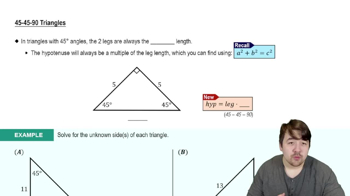
45-45-90 Triangles
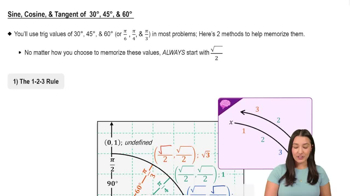
Trigonometric Ratios (Sine, Cosine, Tangent)
Sine, cosine, and tangent are ratios defined for an acute angle in a right triangle: sine is opposite/hypotenuse, cosine is adjacent/hypotenuse, and tangent is opposite/adjacent. These ratios help find missing sides or angles when some measurements are known.
Recommended video:
Sine, Cosine, & Tangent of 30°, 45°, & 60°
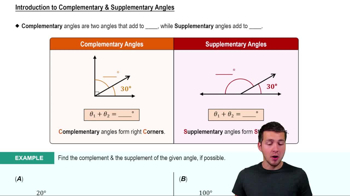
Angle Sum and Complementary Angles in Triangles
The sum of angles in any triangle is 180°. In a right triangle, the two acute angles are complementary, summing to 90°. Understanding this helps identify which trigonometric ratios to use based on the given angles and sides.
Recommended video:
Intro to Complementary & Supplementary Angles
Related Videos
Related Practice
Textbook Question
608
views