Sketch an angle θ in standard position such that θ has the least positive measure, and the given point is on the terminal side of θ. Then find the values of the six trigonometric functions for each angle. Rationalize denominators when applicable. See Examples 1, 2, and 4. (0, ―3)
Table of contents
- 0. Review of College Algebra4h 45m
- 1. Measuring Angles40m
- 2. Trigonometric Functions on Right Triangles2h 5m
- 3. Unit Circle1h 19m
- 4. Graphing Trigonometric Functions1h 19m
- 5. Inverse Trigonometric Functions and Basic Trigonometric Equations1h 41m
- 6. Trigonometric Identities and More Equations2h 34m
- 7. Non-Right Triangles1h 38m
- 8. Vectors2h 25m
- 9. Polar Equations2h 5m
- 10. Parametric Equations1h 6m
- 11. Graphing Complex Numbers1h 7m
2. Trigonometric Functions on Right Triangles
Trigonometric Functions on Right Triangles
Problem 32
Textbook Question
Concept Check Suppose that the point (x, y) is in the indicated quadrant. Determine whether the given ratio is positive or negative. Recall that r = √(x² + y²) .(Hint: Drawing a sketch may help.) III , y/r
Verified step by step guidance1
Recall that the ratio given is \( \frac{y}{r} \), where \( r = \sqrt{x^2 + y^2} \). Since \( r \) is the distance from the origin to the point \( (x, y) \), it is always positive.
Identify the quadrant: The point \( (x, y) \) is in Quadrant III. In this quadrant, both \( x \) and \( y \) coordinates are negative.
Since \( y \) is negative in Quadrant III and \( r \) is positive, the ratio \( \frac{y}{r} \) will have the sign of \( y \), which is negative.
Therefore, the ratio \( \frac{y}{r} \) is negative in Quadrant III.
To visualize this, sketch the coordinate plane, mark Quadrant III, plot a point with negative \( x \) and \( y \), and note that \( r \) is the hypotenuse (always positive), confirming the sign of the ratio.
Verified video answer for a similar problem:This video solution was recommended by our tutors as helpful for the problem above
Video duration:
2mPlay a video:
0 Comments
Key Concepts
Here are the essential concepts you must grasp in order to answer the question correctly.
Coordinate Plane Quadrants
The coordinate plane is divided into four quadrants, each with specific sign conventions for x and y coordinates. In Quadrant III, both x and y values are negative. Understanding the sign of coordinates in each quadrant helps determine the sign of ratios involving x, y, and r.
Recommended video:
Quadratic Formula
Definition of r in the Coordinate Plane
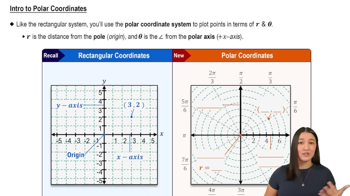
The variable r represents the distance from the origin to the point (x, y), calculated as r = √(x² + y²). Since r is a distance, it is always positive regardless of the quadrant. This positivity affects the sign of ratios involving r.
Recommended video:
Intro to Polar Coordinates
Sign of Ratios Involving Coordinates and r
Ratios like y/r depend on the signs of numerator and denominator. Since r is always positive, the sign of y/r is determined solely by y. In Quadrant III, y is negative, so y/r is negative. This concept is key to evaluating the sign of trigonometric ratios.
Recommended video:
Intro to Polar Coordinates
Related Videos
Related Practice
Textbook Question
579
views