Verify that each equation is an identity. 2 cos³ x - cos x = (cos² x - sin² x)/sec x
Verified step by step guidance
1
Start by rewriting the right-hand side (RHS) of the equation to express everything in terms of sine and cosine functions. Recall that \(\sec x = \frac{1}{\cos x}\), so rewrite the RHS as \(\frac{\cos^{2} x - \sin^{2} x}{\sec x} = (\cos^{2} x - \sin^{2} x) \cdot \cos x\).
Recognize that \(\cos^{2} x - \sin^{2} x\) is a well-known trigonometric identity equal to \(\cos 2x\). So, the RHS becomes \(\cos 2x \cdot \cos x\).
Now, focus on the left-hand side (LHS), which is \(2 \cos^{3} x - \cos x\). Factor out \(\cos x\) to get \(\cos x (2 \cos^{2} x - 1)\).
Recall the double-angle identity for cosine: \(\cos 2x = 2 \cos^{2} x - 1\). Substitute this into the factored LHS to get \(\cos x \cdot \cos 2x\).
Since both the LHS and RHS simplify to \(\cos x \cdot \cos 2x\), the original equation is verified as an identity.
Verified video answer for a similar problem:
This video solution was recommended by our tutors as helpful for the problem above
Play a video:
0 Comments
Key Concepts
Here are the essential concepts you must grasp in order to answer the question correctly.
Trigonometric Identities
Trigonometric identities are equations involving trigonometric functions that hold true for all values within their domains. Verifying an identity means showing both sides simplify to the same expression using known formulas, such as Pythagorean identities or angle formulas.
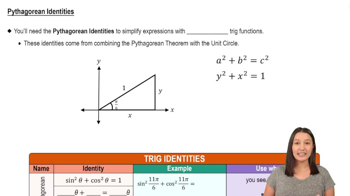
Pythagorean identities relate sine and cosine functions, such as sin²x + cos²x = 1. These identities are fundamental for rewriting expressions and simplifying trigonometric equations by substituting one function in terms of another.
Reciprocal identities express functions like sec x as 1/cos x, which helps in simplifying complex fractions. Power reduction formulas and expressions for powers of cosine, like cos³x, allow rewriting higher powers into products or sums of trigonometric functions for easier manipulation.

 Verified step by step guidance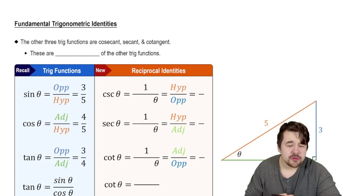
 5:32
5:32