Let csc x = -3. Find all possible values of (sin x + cos x)/sec x.
Verified step by step guidance
1
Start by recalling the given information: \( \csc x = -3 \). Since \( \csc x = \frac{1}{\sin x} \), use this to find \( \sin x \) by taking the reciprocal, so \( \sin x = \frac{1}{\csc x} \).
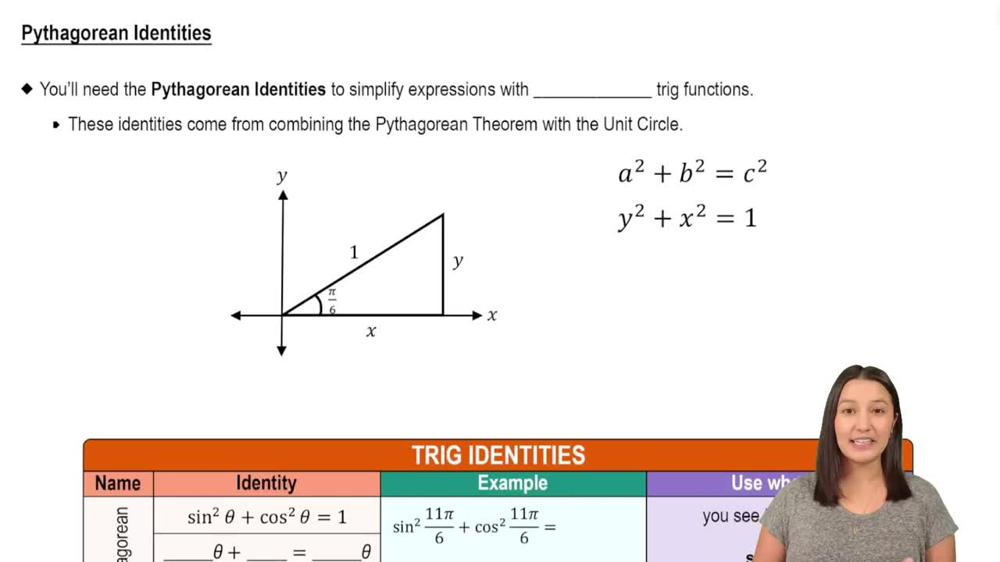
Next, find \( \cos x \) using the Pythagorean identity: \( \sin^2 x + \cos^2 x = 1 \). Substitute the value of \( \sin x \) you found and solve for \( \cos x \). Remember that \( \cos x \) can be positive or negative depending on the quadrant where \( x \) lies.
Determine the possible quadrants for \( x \) based on the sign of \( \csc x = -3 \). Since \( \csc x \) is negative, \( \sin x \) is negative, which restricts \( x \) to quadrants III and IV. Use this to decide the sign of \( \cos x \) in each quadrant.
Recall that \( \sec x = \frac{1}{\cos x} \). Use this to rewrite the expression \( \frac{\sin x + \cos x}{\sec x} \) as \( (\sin x + \cos x) \times \cos x \).
Substitute the values of \( \sin x \) and \( \cos x \) into the expression \( (\sin x + \cos x) \times \cos x \) and simplify. Consider both possible signs of \( \cos x \) to find all possible values.
Verified video answer for a similar problem:
This video solution was recommended by our tutors as helpful for the problem above
Play a video:
0 Comments
Key Concepts
Here are the essential concepts you must grasp in order to answer the question correctly.
Reciprocal Trigonometric Functions
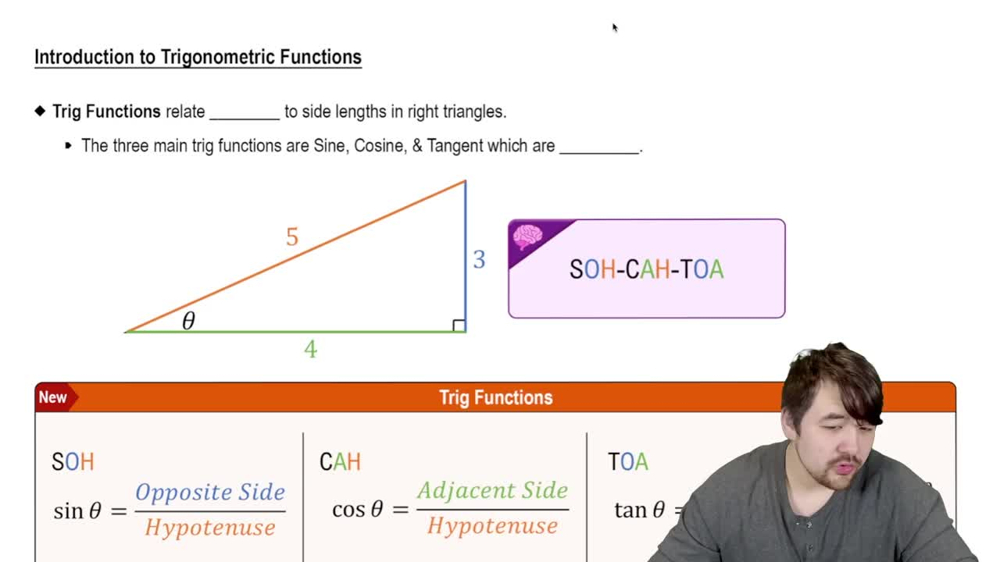
Reciprocal functions relate pairs like sine and cosecant, cosine and secant. For example, csc x = 1/sin x and sec x = 1/cos x. Knowing these relationships helps convert given values into more usable forms for solving equations.
The Pythagorean identity states that sin²x + cos²x = 1. This fundamental relation allows finding one trigonometric value when the other is known, essential for determining cos x when sin x is given or vice versa.
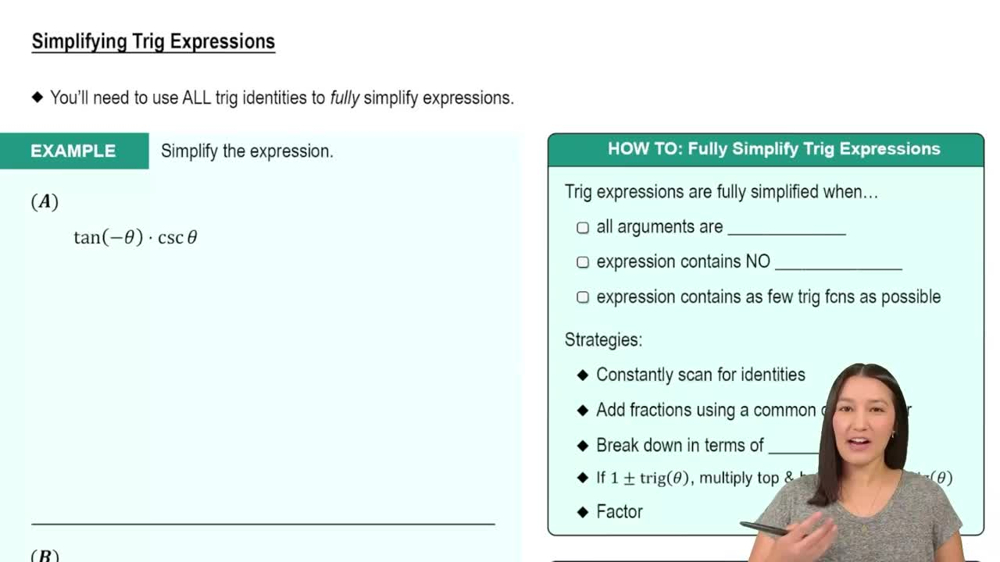
Simplifying expressions like (sin x + cos x)/sec x involves rewriting sec x as 1/cos x and then manipulating the expression algebraically. This process often reduces complex fractions to simpler forms, making it easier to substitute known values and solve.