In Exercises 1–6, the measure of an angle is given. Classify the angle as acute, right, obtuse, or straight. 87.177°
Ch. 1 - Angles and the Trigonometric Functions

Chapter 1, Problem 2
Find the length of the arc on a circle of radius 20 feet intercepted by a 75° central angle. Express arc length in terms of 𝜋. Then round your answer to two decimal places.
Verified step by step guidance1
Identify the given values: the radius \(r = 20\) feet and the central angle \(\theta = 75^\circ\).
Recall the formula for the length of an arc: \(L = r \times \theta\), where \(\theta\) must be in radians.
Convert the central angle from degrees to radians using the conversion \(\theta_{rad} = \theta_{deg} \times \frac{\pi}{180}\), so calculate \(75^\circ \times \frac{\pi}{180}\).
Substitute the radius and the radian measure of the angle into the arc length formula: \(L = 20 \times \left(75 \times \frac{\pi}{180}\right)\).
Simplify the expression to write the arc length in terms of \(\pi\), then use a calculator to approximate the decimal value and round it to two decimal places.

Verified video answer for a similar problem:
This video solution was recommended by our tutors as helpful for the problem above.
Video duration:
3mWas this helpful?
Key Concepts
Here are the essential concepts you must grasp in order to answer the question correctly.
Arc Length Formula
The arc length of a circle is the distance along the curved line forming part of the circle's circumference. It is calculated using the formula s = rθ, where r is the radius and θ is the central angle in radians. This formula connects linear and angular measurements on a circle.
Recommended video:
Finding Missing Side Lengths
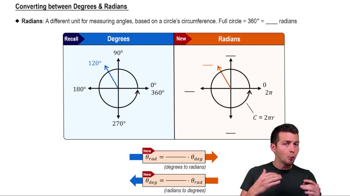
Conversion Between Degrees and Radians
Angles can be measured in degrees or radians. Since the arc length formula requires the angle in radians, convert degrees to radians by multiplying by π/180. For example, 75° equals (75 × π/180) radians, which is essential for accurate calculation.
Recommended video:
Converting between Degrees & Radians
Rounding and Expressing Answers in Terms of π
Expressing the arc length in terms of π keeps the answer exact and symbolic. After finding the exact value, you can approximate the decimal value by substituting π ≈ 3.1416 and rounding to the desired decimal places, such as two decimals, for practical use.
Recommended video:
Multiplying Complex Numbers
Related Practice
Textbook Question
616
views
Textbook Question
A point P(x, y) is shown on the unit circle corresponding to a real number t. Find the values of the trigonometric functions at t.
<IMAGE>
385
views
Textbook Question
Use the unit circle shown to find the value of the trigonometric function.
cos 𝜋/6
607
views
Textbook Question
In Exercises 1–4, a point P(x, y) is shown on the unit circle corresponding to a real number t. Find the values of the trigonometric functions at t.
813
views
Textbook Question
In Exercises 1–8, use the Pythagorean Theorem to find the length of the missing side of each right triangle. Then find the value of each of the six trigonometric functions of θ.
1359
views
Textbook Question
In Exercises 2–4, convert each angle in degrees to radians. Express your answer as a multiple of 𝜋. 15°
547
views