In Exercises 7–12, find the radian measure of the central angle of a circle of radius r that intercepts an arc of length s. Radius, r: 10 inches Arc Length, s: 40 inches
Ch. 1 - Angles and the Trigonometric Functions

Chapter 1, Problem 8
In Exercises 1–8, a point on the terminal side of angle θ is given. Find the exact value of each of the six trigonometric functions of θ. (-1, -3)
Verified step by step guidance1
Identify the coordinates of the point on the terminal side of angle \( \theta \). Here, the point is \((-1, -3)\), so \(x = -1\) and \(y = -3\).
Calculate the radius \(r\), which is the distance from the origin to the point, using the formula \( r = \sqrt{x^2 + y^2} \). Substitute the values to get \( r = \sqrt{(-1)^2 + (-3)^2} \).
Recall the definitions of the six trigonometric functions in terms of \(x\), \(y\), and \(r\):
\[ \sin \theta = \frac{y}{r}, \quad \cos \theta = \frac{x}{r}, \quad \tan \theta = \frac{y}{x}, \quad \csc \theta = \frac{r}{y}, \quad \sec \theta = \frac{r}{x}, \quad \cot \theta = \frac{x}{y} \]
Substitute the values of \(x\), \(y\), and \(r\) into each of the six functions to express them exactly in terms of radicals and integers.
Simplify each expression if possible, and pay attention to the signs of the functions based on the quadrant where the point \((-1, -3)\) lies (which is the third quadrant).

Verified video answer for a similar problem:
This video solution was recommended by our tutors as helpful for the problem above.
Video duration:
8mWas this helpful?
Key Concepts
Here are the essential concepts you must grasp in order to answer the question correctly.
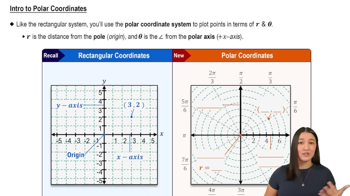
Coordinates and the Terminal Side of an Angle
The terminal side of an angle θ in standard position passes through a point (x, y). This point helps determine the angle's trigonometric values by relating x and y to the radius (r), which is the distance from the origin to the point.
Recommended video:
Intro to Polar Coordinates
Radius (r) and Its Calculation
The radius r is the distance from the origin to the point (x, y) on the terminal side, calculated using the Pythagorean theorem: r = √(x² + y²). It is essential for normalizing the coordinates when finding trigonometric function values.
Recommended video:
Calculating Area of ASA Triangles
Six Trigonometric Functions and Their Definitions
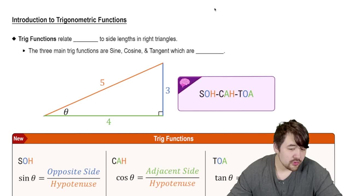
The six trigonometric functions—sine, cosine, tangent, cosecant, secant, and cotangent—are defined using x, y, and r: sin θ = y/r, cos θ = x/r, tan θ = y/x, and their reciprocals csc θ, sec θ, cot θ. Knowing these definitions allows exact value computation from coordinates.
Recommended video:
Introduction to Trigonometric Functions
Related Practice
Textbook Question
1042
views
Textbook Question
In Exercises 8–12, draw each angle in standard position. 5𝜋 6
771
views
Textbook Question
In Exercises 5–7, convert each angle in radians to degrees. - 5𝜋 6
557
views
Textbook Question
In Exercises 5–18, the unit circle has been divided into twelve equal arcs, corresponding to t-values of 0, 𝜋, 𝜋, 𝜋, 2𝜋, 5𝜋, 𝜋, 7𝜋, 4𝜋, 3𝜋, 5𝜋, 11𝜋, and 2𝜋. 6 3 2 3 6 6 3 2 3 6 Use the (x,y) coordinates in the figure to find the value of each trigonometric function at the indicated real number, t, or state that the expression is undefined.
cos 2𝜋/3
3308
views
1
rank
Textbook Question
In Exercises 7–12, find the radian measure of the central angle of a circle of radius r that intercepts an arc of length s. Radius, r: 6 yards Arc Length, s: 8 yards
699
views
Textbook Question
In Exercises 8–13, find the exact value of each expression. Do not use a calculator. tan 300°
704
views