In Exercises 1–8, a point on the terminal side of angle θ is given. Find the exact value of each of the six trigonometric functions of θ. (-4, 3)
Ch. 1 - Angles and the Trigonometric Functions

Chapter 1, Problem 1.1.71
In Exercises 71–74, find the length of the arc on a circle of radius r intercepted by a central angle θ. Express arc length in terms of 𝜋. Then round your answer to two decimal places. Radius, r: 12 inches Central Angle, θ: θ = 45°
Verified step by step guidance1
Recall the formula for the length of an arc \(s\) intercepted by a central angle \(\theta\) on a circle of radius \(r\):
\(s = r \times \theta_{\text{radians}}\)
Since the central angle \(\theta\) is given in degrees, convert it to radians using the conversion factor:
\(\theta_{\text{radians}} = \theta_{\text{degrees}} \times \frac{\pi}{180}\)
Substitute the given values into the conversion formula:
\(\theta_{\text{radians}} = 45 \times \frac{\pi}{180}\)
Now substitute the radius \(r = 12\) inches and the radian measure of \(\theta\) into the arc length formula:
\(s = 12 \times \left(45 \times \frac{\pi}{180}\right)\)
Simplify the expression to write the arc length in terms of \(\pi\), then calculate the decimal approximation and round it to two decimal places.

Verified video answer for a similar problem:
This video solution was recommended by our tutors as helpful for the problem above.
Video duration:
3mWas this helpful?
Key Concepts
Here are the essential concepts you must grasp in order to answer the question correctly.
Arc Length Formula
The arc length of a circle is the distance along the curved line between two points on the circle. It is calculated using the formula s = rθ, where r is the radius and θ is the central angle in radians. This formula directly relates the angle and radius to the length of the arc.
Recommended video:
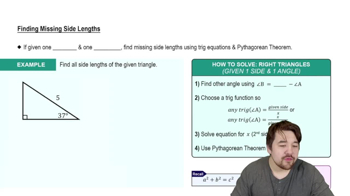
Finding Missing Side Lengths
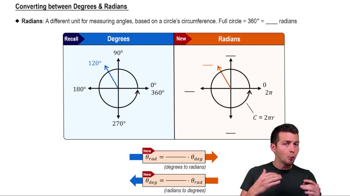
Conversion Between Degrees and Radians
Since the arc length formula requires the central angle in radians, it is essential to convert degrees to radians. The conversion is done by multiplying degrees by π/180. For example, 45° equals 45 × (π/180) = π/4 radians.
Recommended video:
Converting between Degrees & Radians
Expressing Answers in Terms of π and Decimal Approximation
After calculating the arc length in terms of π, it is often useful to provide a decimal approximation for practical use. This involves substituting π ≈ 3.1416 and rounding the result to the desired decimal places, such as two decimals, to balance precision and readability.
Recommended video:
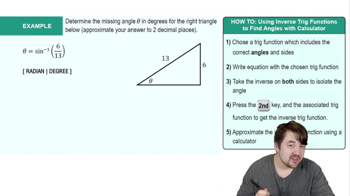
Example 1
Related Practice
Textbook Question
542
views
Textbook Question
In Exercises 63–68, find the exact value of each expression. Do not use a calculator. cos 12° sin 78° + cos 78° sin 12°
591
views
Textbook Question
In Exercises 63–68, find the exact value of each expression. Do not use a calculator. tan(𝜋/3)/2 - 1/sec(𝜋/6)
612
views
Textbook Question
In Exercises 41–56, use the circle shown in the rectangular coordinate system to draw each angle in standard position. State the quadrant in which the angle lies. When an angle's measure is given in radians, work the exercise without converting to degrees.
120°
635
views
Textbook Question
In Exercises 57–70, find a positive angle less than or that is coterminal with the given angle. 395°
679
views
Textbook Question
In Exercises 61–86, use reference angles to find the exact value of each expression. Do not use a calculator. cot(7𝜋/4)
657
views