In Exercises 29–51, find the exact value of each expression. Do not use a calculator. sec⁻¹ (−1)
Ch. 2 - Graphs of the Trigonometric Functions; Inverse Trigonometric Functions

All textbooks
Blitzer 3rd Edition
Ch. 2 - Graphs of the Trigonometric Functions; Inverse Trigonometric Functions
Problem 37
Blitzer 3rd Edition
Ch. 2 - Graphs of the Trigonometric Functions; Inverse Trigonometric Functions
Problem 37Chapter 2, Problem 37
In Exercises 35–42, determine the amplitude and period of each function. Then graph one period of the function. y = 4 cos 2πx
Verified step by step guidance1
Identify the general form of the cosine function, which is \(y = A \cos(Bx)\), where \(A\) represents the amplitude and \(B\) affects the period of the function.
Determine the amplitude \(A\) by taking the absolute value of the coefficient in front of the cosine function. In this case, \(A = |4|\).
Find the period of the function using the formula \(\text{Period} = \frac{2\pi}{B}\), where \(B\) is the coefficient of \(x\) inside the cosine function. Here, \(B = 2\pi\).
Calculate the period by substituting \(B = 2\pi\) into the formula: \(\text{Period} = \frac{2\pi}{2\pi}\).
To graph one period of the function, plot the cosine curve starting at \(x = 0\) and ending at \(x\) equal to the period found in the previous step, using the amplitude to mark the maximum and minimum values on the \(y\)-axis.

Verified video answer for a similar problem:
This video solution was recommended by our tutors as helpful for the problem above.
Video duration:
7mWas this helpful?
Key Concepts
Here are the essential concepts you must grasp in order to answer the question correctly.
Amplitude of a Trigonometric Function
Amplitude is the maximum absolute value of a trigonometric function from its midline. For functions like y = a cos bx, the amplitude is |a|, representing the peak height of the wave. In this question, the amplitude determines how far the graph stretches vertically from the center line.
Recommended video:
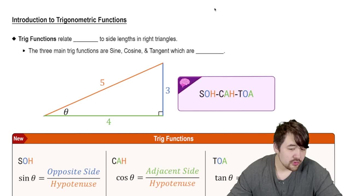
Introduction to Trigonometric Functions
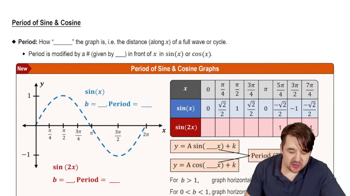
Period of a Trigonometric Function
The period is the length of one complete cycle of the function along the x-axis. For y = cos(bx), the period is calculated as (2π) / |b|. It tells us how frequently the function repeats its pattern, which is essential for graphing one full wave.
Recommended video:
Period of Sine and Cosine Functions
Graphing One Period of a Cosine Function
Graphing one period involves plotting the function from x = 0 to x = period, showing key points like maxima, minima, and zeros. Understanding amplitude and period helps accurately sketch the wave's shape and length, providing a visual representation of the function's behavior.
Recommended video:
Period of Sine and Cosine Functions
Related Practice
Textbook Question
757
views
Textbook Question
In Exercises 37–40, an object moves in simple harmonic motion described by the given equation, where t is measured in seconds and d in inches. In each exercise, graph one period of the equation. Then find the following: a. the maximum displacement b. the frequency c. the time required for one cycle d. the phase shift of the motion. d = 3 cos(πt + π/2)
901
views
Textbook Question
In Exercises 29–44, graph two periods of the given cosecant or secant function. y = sec x/3
683
views
Textbook Question
Graph two periods of the given cosecant or secant function.
y = sec x/2
570
views
Textbook Question
In Exercises 29–44, graph two periods of the given cosecant or secant function. y = −2 csc πx
720
views
Textbook Question
In Exercises 27–38, use a calculator to find the value of each expression rounded to two decimal places. ___ tan⁻¹ (−√473)
758
views