In Exercises 54–67, solve each equation on the interval [0, 2𝝅). Use exact values where possible or give approximate solutions correct to four decimal places. sin 2x = √ 3 sin x
Ch. 3 - Trigonometric Identities and Equations

Chapter 3, Problem 3.RE.35b
In Exercises 35–38, find the exact value of the following under the given conditions: b. cos(α﹣β)
sin α = 3/5, 0 < α < 𝝅/2, and sin β = 12/13, 𝝅/2 < β < 𝝅.
Verified step by step guidance1
Identify the given information: \( \sin \alpha = \frac{3}{5} \) with \( 0 < \alpha < \frac{\pi}{2} \), and \( \sin \beta = \frac{12}{13} \) with \( \frac{\pi}{2} < \beta < \pi \).
Determine the quadrant of each angle to find the signs of \( \cos \alpha \) and \( \cos \beta \). Since \( \alpha \) is in the first quadrant, \( \cos \alpha > 0 \). Since \( \beta \) is in the second quadrant, \( \cos \beta < 0 \).
Use the Pythagorean identity to find \( \cos \alpha \) and \( \cos \beta \):
\[ \cos \theta = \pm \sqrt{1 - \sin^2 \theta} \]
Calculate:
\[ \cos \alpha = +\sqrt{1 - \left(\frac{3}{5}\right)^2} \]
\[ \cos \beta = -\sqrt{1 - \left(\frac{12}{13}\right)^2} \]
Recall the cosine difference identity:
\[ \cos(\alpha - \beta) = \cos \alpha \cos \beta + \sin \alpha \sin \beta \]
Substitute the values of \( \sin \alpha \), \( \sin \beta \), \( \cos \alpha \), and \( \cos \beta \) into the identity to express \( \cos(\alpha - \beta) \) exactly.

Verified video answer for a similar problem:
This video solution was recommended by our tutors as helpful for the problem above.
Video duration:
7mWas this helpful?
Key Concepts
Here are the essential concepts you must grasp in order to answer the question correctly.
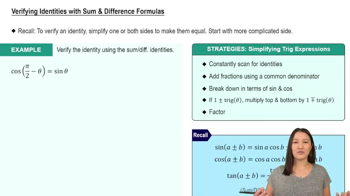
Sum and Difference Formulas for Cosine
The cosine of the difference of two angles, cos(α - β), can be found using the formula cos(α - β) = cos α cos β + sin α sin β. This identity allows us to express the cosine of a difference in terms of the sines and cosines of the individual angles, which is essential when given sine values and angle ranges.
Recommended video:
Verifying Identities with Sum and Difference Formulas
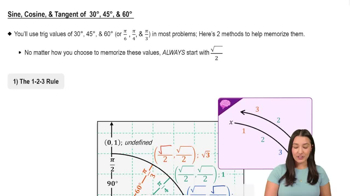
Determining Cosine from Sine and Quadrant Information
Given sin α and sin β along with their angle ranges, we can find cos α and cos β using the Pythagorean identity cos²θ = 1 - sin²θ. The sign of cosine depends on the quadrant of the angle, so knowing the interval for α and β helps determine whether cosine is positive or negative.
Recommended video:
Sine, Cosine, & Tangent of 30°, 45°, & 60°
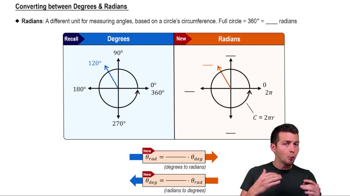
Angle Measurement in Radians and Quadrant Boundaries
Angles are given in radians with specified intervals (e.g., 0 < α < 3π/2). Understanding these intervals helps identify the quadrant in which each angle lies, which is crucial for determining the signs of trigonometric functions and correctly applying identities.
Recommended video:
Converting between Degrees & Radians
Related Practice
Textbook Question
658
views
Textbook Question
In Exercises 39–42, use double- and half-angle formulas to find the exact value of each expression. sin 22.5°
729
views
Textbook Question
In Exercises 35–38, find the exact value of the following under the given conditions:
b. cos(α﹣β)
sin α = -1/3, 𝝅 < α < 3𝝅/2, and cos β = -1/3, 𝝅 < β < 3𝝅/2.
992
views
Textbook Question
In Exercises 54–67, solve each equation on the interval [0, 2𝝅). Use exact values where possible or give approximate solutions correct to four decimal places. cos 2x = -1
527
views
Textbook Question
In Exercises 35–38, find the exact value of the following under the given conditions:
c. tan(α + β)
sin α = 3/5, 0 < α < 𝝅/2, and sin β = 12/13, 𝝅/2 < β < 𝝅.
843
views
Textbook Question
In Exercises 50–53, find all solutions of each equation. cos x = ﹣1/2
485
views