Find the measure of each marked angle. See Example 2 complementary angles with measures 3𝓍 ― 5 and 6𝓍 ― 40 degrees
Ch. 1 - Trigonometric Functions
Chapter 2, Problem 31
Determine the signs of the trigonometric functions of an angle in standard position with the given measure. See Example 2.
178°
Verified step by step guidance1
Identify the quadrant in which the angle 178° lies. Since 178° is between 90° and 180°, it lies in the second quadrant.
Recall the signs of the trigonometric functions in the second quadrant: sine (sin) is positive, cosine (cos) is negative, and tangent (tan) is negative.
Use the reference angle to understand the values better. The reference angle for 178° is calculated as \(180^\circ - 178^\circ = 2^\circ\).
Determine the signs of the reciprocal functions based on the signs of sine, cosine, and tangent: cosecant (csc) has the same sign as sine, secant (sec) has the same sign as cosine, and cotangent (cot) has the same sign as tangent.
Summarize the signs: sin(178°) > 0, cos(178°) < 0, tan(178°) < 0, csc(178°) > 0, sec(178°) < 0, cot(178°) < 0.

Verified video answer for a similar problem:
This video solution was recommended by our tutors as helpful for the problem above.
Video duration:
2mWas this helpful?
Key Concepts
Here are the essential concepts you must grasp in order to answer the question correctly.
Standard Position of an Angle
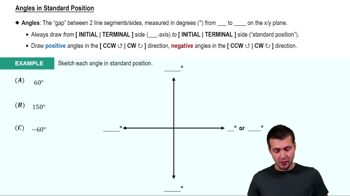
An angle in standard position has its vertex at the origin and its initial side along the positive x-axis. The terminal side rotates counterclockwise for positive angles. Understanding this helps locate the angle's terminal side on the coordinate plane, which is essential for determining the signs of trigonometric functions.
Recommended video:
Drawing Angles in Standard Position
Quadrants and Sign of Trigonometric Functions
The coordinate plane is divided into four quadrants, each determining the sign of sine, cosine, and tangent. For example, in the second quadrant (90° to 180°), sine is positive while cosine and tangent are negative. Knowing the quadrant of the angle helps identify the signs of its trigonometric values.
Recommended video:
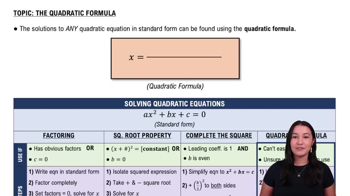
Quadratic Formula
Reference Angle
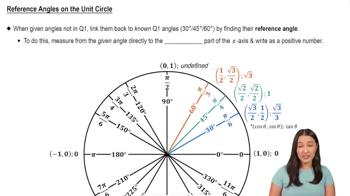
The reference angle is the acute angle formed between the terminal side of the given angle and the x-axis. It helps find the exact values of trigonometric functions by relating them to known angles in the first quadrant, while the quadrant determines the sign. For 178°, the reference angle is 2°.
Recommended video:
Reference Angles on the Unit Circle
Related Practice
Textbook Question
630
views
Textbook Question
Find the values of the six trigonometric functions for an angle in standard position having each given point on its terminal side. Rationalize denominators when applicable. (6√3 , ―6)
582
views
Textbook Question
Find the measure of each marked angle. See Example 2 complementary angles with measures 9𝓍 + 6 and 3𝓍 degrees
605
views
Textbook Question
Find the measure of each marked angle. See Example 2 supplementary angles with measures 6𝓍 - 4 and 8𝓍 - 12 degrees
608
views
Textbook Question
The measures of two angles of a triangle are given. Find the measure of the third angle. See Example 2.
17° 41' 13" , 96° 12' 10"
988
views
Textbook Question
Concept Check Suppose that the point (x, y) is in the indicated quadrant. Determine whether the given ratio is positive or negative. Recall that r = √(x² + y²) .(Hint: Drawing a sketch may help.) III , y/r
553
views