
Sketch an angle θ in standard position such that θ has the least positive measure, and the given point is on the terminal side of θ. Then find the values of the six trigonometric functions for each angle. Rationalize denominators when applicable. See Examples 1, 2, and 4. (―8 , 15)
Ch. 1 - Trigonometric Functions
Chapter 2, Problem 15
Find the measure of (a) the complement and (b) the supplement of an angle with the given measure. See Examples 1 and 3. 54°
Verified step by step guidance1
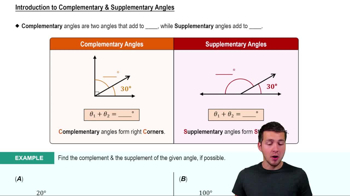
Understand the definitions: The complement of an angle is what, when added to the angle, equals 90°. The supplement of an angle is what, when added to the angle, equals 180°.
To find the complement of the given angle (54°), set up the equation: \(\text{complement} + 54^\circ = 90^\circ\).
Solve for the complement by subtracting 54° from 90°: \(\text{complement} = 90^\circ - 54^\circ\).
To find the supplement of the given angle (54°), set up the equation: \(\text{supplement} + 54^\circ = 180^\circ\).
Solve for the supplement by subtracting 54° from 180°: \(\text{supplement} = 180^\circ - 54^\circ\).

Verified video answer for a similar problem:
This video solution was recommended by our tutors as helpful for the problem above.
Video duration:
2mWas this helpful?
Key Concepts
Here are the essential concepts you must grasp in order to answer the question correctly.
Complementary Angles
Complementary angles are two angles whose measures add up to 90 degrees. To find the complement of a given angle, subtract the angle's measure from 90°. For example, the complement of 54° is 90° - 54° = 36°.
Recommended video:
Intro to Complementary & Supplementary Angles
Supplementary Angles
Supplementary angles are two angles whose measures add up to 180 degrees. To find the supplement of a given angle, subtract the angle's measure from 180°. For example, the supplement of 54° is 180° - 54° = 126°.
Recommended video:
Intro to Complementary & Supplementary Angles
Angle Measurement and Units
Angles are measured in degrees, representing the amount of rotation between two rays. Understanding how to manipulate and interpret these measurements is essential for solving problems involving complements and supplements.
Recommended video:
Reference Angles on the Unit Circle
Related Practice
Textbook Question
595
views
Textbook Question
Find the measure of each marked angle.
696
views
Textbook Question
Find the measure of (a) the complement and (b) the supplement of an angle with the given measure. See Examples 1 and 3. 10°
745
views
Textbook Question
Find the measure of each marked angle. In Exercises 19–22, m and n are parallel. See Examples 1 and 2 .
754
views
Textbook Question
Find the measure of each marked angle. In Exercises 19–22, m and n are parallel.
<IMAGE>
450
views
Textbook Question
Solve each problem. Length of a Road A camera is located on a satellite with its lens positioned at C in the figure. Length PC represents the distance from the lens to the film PQ, and BA represents a straight road on the ground. Use the measurements given in the figure to find the length of the road. (Data from Kastner, B., Space Mathematics, NASA.)
695
views
