
Ch. 2 - Acute Angles and Right Triangles
Lial - Trigonometry 12th Edition
Lial12th EditionTrigonometryISBN: 9780136552161Not the one you use?Change textbook
Chapter 3, Problem 2.3.11

Use a calculator to approximate the value of each expression. Give answers to six decimal places. In Exercises 21–28, simplify the expression before using the calculator. See Example 1.
sin 38° 42'

Verified step by step guidance
1
First, convert the angle given in degrees and minutes to a decimal degree format. Recall that 1 minute is equal to \( \frac{1}{60} \) degrees. So, convert 42 minutes to degrees by calculating \( 42 \times \frac{1}{60} \).
Add the decimal degree value from the minutes to the whole degrees to get the total angle in decimal degrees: \( 38 + \text{(decimal from minutes)} \).
Use the sine function on your calculator with the angle in decimal degrees. Make sure your calculator is set to degree mode, not radians.
Calculate \( \sin(\text{decimal degrees}) \) using the calculator.
Round the result to six decimal places as requested.

Verified video answer for a similar problem:

This video solution was recommended by our tutors as helpful for the problem above.
Video duration:
2m
Was this helpful?

Key Concepts

Here are the essential concepts you must grasp in order to answer the question correctly.

Angle Measurement in Degrees and Minutes

Angles can be expressed in degrees, minutes, and seconds, where 1 degree equals 60 minutes. To use a calculator, convert the angle from degrees and minutes to a decimal degree by dividing the minutes by 60 and adding to the degrees. For example, 38° 42' equals 38 + 42/60 = 38.7 degrees.
Recommended video:
5:31
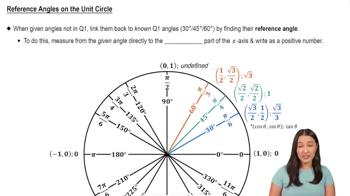
Reference Angles on the Unit Circle

Using the Sine Function on a Calculator

The sine function relates an angle in a right triangle to the ratio of the opposite side over the hypotenuse. Calculators compute sine values using the angle in degrees or radians, so ensure the calculator is set to degree mode when inputting angles in degrees. This allows accurate evaluation of sin(38.7°).
Recommended video:
4:45
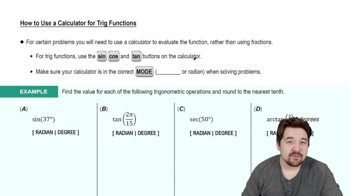
How to Use a Calculator for Trig Functions

Rounding and Precision in Calculations

When approximating trigonometric values, it is important to round the result to the specified number of decimal places for consistency and clarity. Here, answers should be rounded to six decimal places, which means keeping six digits after the decimal point, ensuring precision in the final answer.
Recommended video:
4:45
How to Use a Calculator for Trig Functions
Related Practice
Textbook Question

Solve each problem. See Examples 1 and 2. Distance between Two Cities The bearing from Atlanta to Macon is S 27° E, and the bearing from Macon to Augusta is N 63° E. An automobile traveling at 62 mph needs 1¼ hr to go from Atlanta to Macon and 1¾ hr to go from Macon to Augusta. Find the distance from Atlanta to Augusta.

817
views
Textbook Question

(Modeling) Grade Resistance Solve each problem. See Example 3. A car traveling on a -3° downhill grade has a grade resistance of -145 lb. Determine the weight of the car to the nearest hundred pounds.

655
views
Textbook Question

Use a calculator to approximate the value of each expression. Give answers to six decimal places. In Exercises 21–28, simplify the expression before using the calculator. See Example 1.

1/ sec 14.8°

587
views
Textbook Question

CONCEPT PREVIEW Match each trigonometric function value or angle in Column I with its appropriate approximation in Column II.


Column I: 1.

cot⁻¹ 30

Column II:

A. 88.09084757°

B. 63.25631605°

C. 1.909152433°

D. 17.45760312°

E. 0.2867453858

F. 1.962610506

G. 14.47751219°

H. 1.015426612

I. 1.051462224

J. 0.9925461516

617
views
Textbook Question

Concept Check The two methods of expressing bearing can be interpreted using a rectangular coordinate system. Suppose that an observer for a radar station is located at the origin of a coordinate system. Find the bearing of an airplane located at each point. Express the bearing using both methods. (0, -2)

1029
views
Textbook Question

Find two angles in the interval [0°, 360°) that satisfy each of the following. Round answers to the nearest degree. sin θ = 0.52991926

641
views