
Textbook Question
A plane has an airspeed of 520 mph. The pilot wishes to fly on a bearing of 310°. A wind of 37 mph is blowing from a bearing of 212°. In what direction should the pilot fly, and what will be her ground speed?
774
views

 Verified step by step guidance
 4:35
4:35
 4:02
4:02 6:04
6:04A plane has an airspeed of 520 mph. The pilot wishes to fly on a bearing of 310°. A wind of 37 mph is blowing from a bearing of 212°. In what direction should the pilot fly, and what will be her ground speed?
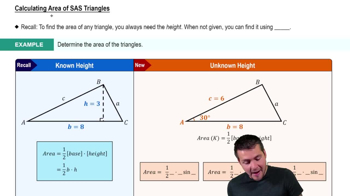
Find the area of each triangle ABC.
B = 124.5°, a = 30.4 cm, c = 28.4 cm
Solve each problem. See Examples 5 and 6.
Bearing and Ground Speed of a Plane An airline route from San Francisco to Honolulu is on a bearing of 233.0°. A jet flying at 450 mph on that bearing encounters a wind blowing at 39.0 mph from a direction of 114.0°. Find the resulting bearing and ground speed of the plane.
Find the force required to keep a 75-lb sled from sliding down an incline that makes an angle of 27° with the horizontal. (Assume there is no friction.)
One boat pulls a barge with a force of 100 newtons. Another boat pulls the barge at an angle of 45° to the first force, with a force of 200 newtons. Find the resultant force acting on the barge, to the nearest unit, and the angle between the resultant and the first boat, to the nearest tenth.
Solve each problem. See Examples 5 and 6.
Distance and Direction of a Motorboat A motorboat sets out in the direction N 80° 00′ E. The speed of the boat in still water is 20.0 mph. If the current is flowing directly south, and the actual direction of the motorboat is due east, find the speed of the current and the actual speed of the motorboat.
<IMAGE>