A plane flies 650 mph on a bearing of 175.3°. A 25-mph wind, from a direction of 266.6°, blows against the plane. Find the resulting bearing of the plane.
Ch. 7 - Applications of Trigonometry and Vectors
Chapter 8, Problem 53
Find the dot product for each pair of vectors.
4i, 5i - 9j
Verified step by step guidance1
Identify the given vectors. The first vector is \(\vec{A} = 4\mathbf{i}\) and the second vector is \(\vec{B} = 5\mathbf{i} - 9\mathbf{j}\).
Recall the formula for the dot product of two vectors \(\vec{A} = a_1\mathbf{i} + a_2\mathbf{j}\) and \(\vec{B} = b_1\mathbf{i} + b_2\mathbf{j}\):
\(\vec{A} \cdot \vec{B} = a_1 b_1 + a_2 b_2\).
Extract the components of each vector: For \(\vec{A}\), \(a_1 = 4\) and \(a_2 = 0\) (since there is no \(\mathbf{j}\) component). For \(\vec{B}\), \(b_1 = 5\) and \(b_2 = -9\).
Substitute the components into the dot product formula:
\(\vec{A} \cdot \vec{B} = (4)(5) + (0)(-9)\).
Simplify the expression by multiplying and adding the terms to find the dot product.

Verified video answer for a similar problem:
This video solution was recommended by our tutors as helpful for the problem above.
Was this helpful?
Key Concepts
Here are the essential concepts you must grasp in order to answer the question correctly.
Vector Components and Notation
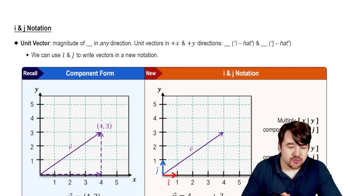
Vectors are often expressed in terms of unit vectors i, j, and k, representing the x, y, and z directions respectively. Understanding how to identify and separate these components is essential for performing operations like the dot product.
Recommended video:
i & j Notation
Dot Product Definition
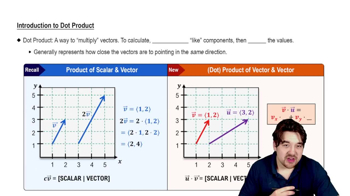
The dot product of two vectors is a scalar obtained by multiplying corresponding components and summing the results. For vectors in two dimensions, it is calculated as (x1 * x2) + (y1 * y2), which measures the extent to which the vectors point in the same direction.
Recommended video:
Introduction to Dot Product
Properties and Applications of the Dot Product
The dot product is commutative and relates to the angle between vectors through the formula A · B = |A||B|cosθ. It is used to find projections, angles, and to determine orthogonality between vectors.
Recommended video:
Introduction to Dot Product
Related Practice
Textbook Question
602
views
Textbook Question
Find the angle between each pair of vectors. Round to two decimal places as necessary.
〈2, 1〉, 〈-3, 1〉
643
views
Textbook Question
Find the area of each triangle ABC.
B = 124.5°, a = 30.4 cm, c = 28.4 cm
739
views
Textbook Question
Solve each problem. See Examples 5 and 6.
Bearing and Ground Speed of a Plane An airline route from San Francisco to Honolulu is on a bearing of 233.0°. A jet flying at 450 mph on that bearing encounters a wind blowing at 39.0 mph from a direction of 114.0°. Find the resulting bearing and ground speed of the plane.
1146
views
Textbook Question
Find the force required to keep a 75-lb sled from sliding down an incline that makes an angle of 27° with the horizontal. (Assume there is no friction.)
623
views
Textbook Question
Find the area of each triangle ABC.
A = 56.80°, b = 32.67 in., c = 52.89 in.
739
views