Ch. R - Algebra Review
Lial - Trigonometry 12th Edition
Lial12th EditionTrigonometryISBN: 9780136552161Not the one you use?Change textbook
Chapter 1, Problem 3

Fill in the blank(s) to correctly complete each sentence.
The graph of ƒ(x) = (x + 4)² is obtained by shifting the graph of y = x² to the ___ 4 units.

Verified step by step guidance
1
Identify the base function and the transformation function. The base function here is y = x^2, which is a standard parabola centered at the origin (0,0).
Analyze the transformation function ƒ(x) = (x + 4)^2. The transformation involves (x + 4) instead of x, indicating a horizontal shift.
Understand the direction of the shift. The +4 inside the parentheses with x indicates a shift to the left if it were -4, it would indicate a shift to the right.
Determine the magnitude of the shift. The number 4 represents the number of units the graph shifts from the original position of the base function.
Conclude the direction and magnitude of the shift. The graph of ƒ(x) = (x + 4)^2 is obtained by shifting the graph of y = x^2 to the left by 4 units.

Verified video answer for a similar problem:

This video solution was recommended by our tutors as helpful for the problem above.
Video duration:
2m
Was this helpful?

Key Concepts

Here are the essential concepts you must grasp in order to answer the question correctly.

Function Transformations

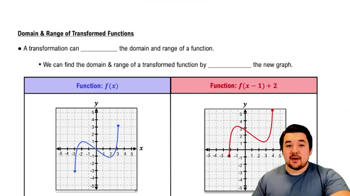
Function transformations involve shifting, stretching, or reflecting the graph of a base function. In this case, adding a constant inside the function's argument shifts the graph horizontally. Understanding how these changes affect the graph is essential for interpreting and sketching functions.
Recommended video:
4:22
Domain and Range of Function Transformations

Horizontal Shifts in Quadratic Functions

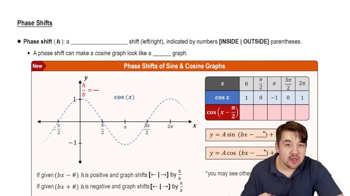
A horizontal shift occurs when a constant is added or subtracted inside the function's input, such as (x + h)². Specifically, f(x) = (x + 4)² shifts the graph of y = x² horizontally by 4 units. The sign inside the parentheses determines the direction of the shift.
Recommended video:
6:31
Phase Shifts

Graph of the Basic Quadratic Function y = x²

The graph of y = x² is a parabola centered at the origin with its vertex at (0,0). It opens upwards and is symmetric about the y-axis. Recognizing this base graph helps in understanding how transformations like shifts affect its position.
Recommended video:
6:22
Graphs of Secant and Cosecant Functions