Find each sum or difference. See Example 1. -6 + (-13)
Ch. R - Algebra Review
Chapter 1, Problem 11
For the points P and Q, find (a) the distance d(P, Q) and (b) the coordinates of the midpoint M of line segment PQ. See Examples 1 and 2. P(-5, -6), Q(7, -1)
Verified step by step guidance1
Identify the coordinates of points P and Q: P has coordinates (-5, -6) and Q has coordinates (7, -1).
To find the distance d(P, Q) between points P and Q, use the distance formula: \[d = \sqrt{(x_2 - x_1)^2 + (y_2 - y_1)^2}\] where \((x_1, y_1)\) are the coordinates of P and \((x_2, y_2)\) are the coordinates of Q.
Substitute the coordinates into the distance formula: \[d = \sqrt{(7 - (-5))^2 + (-1 - (-6))^2}\] and simplify inside the parentheses.
To find the midpoint M of the line segment PQ, use the midpoint formula: \[M = \left( \frac{x_1 + x_2}{2}, \frac{y_1 + y_2}{2} \right)\] where \((x_1, y_1)\) and \((x_2, y_2)\) are the coordinates of P and Q respectively.
Substitute the coordinates into the midpoint formula: \[M = \left( \frac{-5 + 7}{2}, \frac{-6 + (-1)}{2} \right)\] and simplify the expressions inside the parentheses to find the midpoint coordinates.

Verified video answer for a similar problem:
This video solution was recommended by our tutors as helpful for the problem above.
Video duration:
5mWas this helpful?
Key Concepts
Here are the essential concepts you must grasp in order to answer the question correctly.
Distance Formula
The distance formula calculates the length between two points in the coordinate plane. It is derived from the Pythagorean theorem and given by d = √[(x2 - x1)² + (y2 - y1)²], where (x1, y1) and (x2, y2) are the coordinates of the points.
Recommended video:
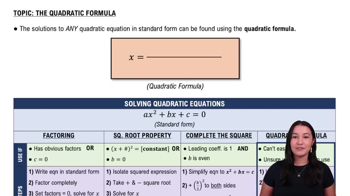
Quadratic Formula
Midpoint Formula
The midpoint formula finds the point exactly halfway between two given points. It is calculated by averaging the x-coordinates and y-coordinates separately: M = ((x1 + x2)/2, (y1 + y2)/2). This gives the coordinates of the midpoint on the line segment.
Recommended video:
Quadratic Formula
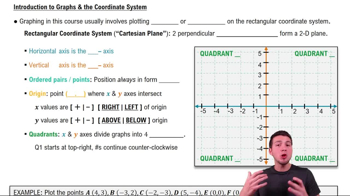
Coordinate Geometry Basics
Coordinate geometry connects algebra and geometry using the coordinate plane. Understanding how points, lines, and distances relate through coordinates is essential for solving problems involving distances and midpoints between points.
Recommended video:
Introduction to Graphs & the Coordinate System
Related Practice
Textbook Question
500
views
Textbook Question
Work each matching problem.
Match each equation in Column I with a description of its graph from Column II as it relates to the graph of y = x².
I II
a. y = (x - 7)² A. a translation to the left 7 units
b. y = x² - 7 B. a translation to the right 7 units
c. y = 7x² C. a translation up 7 units
d. y = (x + 7)² D. a translation down 7 units
e. y = x² + 7 E. a vertical stretching by a factor of 7
390
views
Textbook Question
Find the domain of each rational expression. See Example 1. (x + 3) / (x - 6)
963
views
Textbook Question
Determine whether each relation defines a function. See Example 1. {(5, 1), (3, 2), (4, 9), (7, 8)}
508
views
Textbook Question
List the elements in each set. See Example 1. {x|x is a whole number less than 6}
30
views
Textbook Question
Solve each linear equation. See Examples 1–3. 7x + 8 = 1
82
views