 Back
BackSolutions, Electrolytes, and Chemical Reactions: Analytical Chemistry Study Guide
Study Guide - Smart Notes
 Tailored notes based on your materials, expanded with key definitions, examples, and context.
Solutions and Concentration Units
Solute, Solvent, and Electrolytes
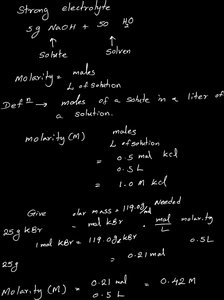
In analytical chemistry, understanding the composition of solutions is fundamental. A solute is the substance dissolved, while the solvent is the medium in which the solute dissolves. Electrolytes are substances that produce ions in solution, classified as strong (completely ionize) or weak (partially ionize).
Example: Dissolving 5 g NaOH in 50 g H2O: NaOH is the solute, H2O is the solvent. NaOH is a strong electrolyte.
Molarity (M)
Molarity is a key unit of concentration, defined as the number of moles of solute per liter of solution:
Example: 0.5 moles KCl in 0.5 L solution:
Example: 25 g KBr (molar mass ≈ 119.0 g/mol) in 0.5 L: mol, M
Calculating Mass or Volume from Molarity
To find the mass of solute in a given volume and molarity, use:
Then, .
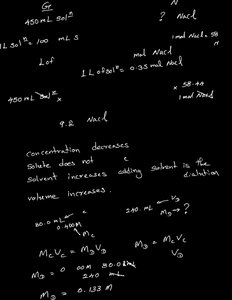
Example: 450 mL of 0.35 M NaCl: mol; g NaCl
Dilution of Solutions
Dilution involves adding solvent to decrease concentration while keeping the amount of solute constant. The relationship is:
Key Points: Volume increases, concentration decreases, solute amount remains unchanged.
Example: Diluting 80.0 mL of 0.400 M NaCl to 240 mL: M
Chemical Reactions in Aqueous Solution
Precipitation and Ionic Equations
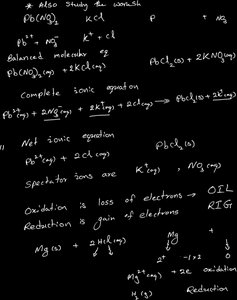
When solutions of ionic compounds are mixed, a precipitate may form if an insoluble compound is produced. Reactions are represented as molecular, complete ionic, and net ionic equations.
Balanced Molecular Equation:
Complete Ionic Equation:
Net Ionic Equation:
Spectator Ions: K+, NO3-
Redox Reactions
Oxidation is the loss of electrons, and reduction is the gain of electrons. These processes are summarized by the mnemonic OIL RIG (Oxidation Is Loss, Reduction Is Gain).
Example: Mg is oxidized (loses electrons), H+ is reduced (gains electrons).
Identifying Strong and Weak Bases
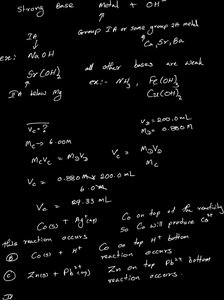
Strong bases are typically hydroxides of Group 1A and 2A metals (e.g., NaOH, KOH, Sr(OH)2). All other bases are considered weak (e.g., NH3, Fe(OH)3).
Example: NaOH and Sr(OH)2 are strong bases; NH3 is a weak base.
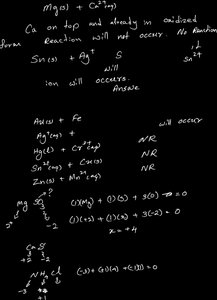
Solubility Rules and Electrolyte Classification
Solubility Rules
Solubility rules help predict the formation of precipitates in double displacement reactions:
All nitrates (NO3-) and ammonium (NH4+) salts are soluble.
Chlorides (Cl-) are generally soluble except with Ag+, Pb2+, and Hg22+.
Sulfates (SO42-) are mostly soluble except with Ba2+, Pb2+, Ca2+.
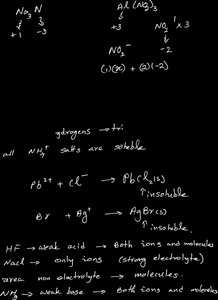
Electrolyte Types
Compound | Type in Solution |
|---|---|
HF (weak acid) | Both ions and molecules |
NaCl (strong electrolyte) | Only ions |
Urea (nonelectrolyte) | Only molecules |
NH3 (weak base) | Both ions and molecules |
Worked Examples and Calculations
Calculating Molarity from Mass and Volume
Example: 60 g NaCl in 350 mL solution:
Moles NaCl = mol
Volume = 0.350 L
M
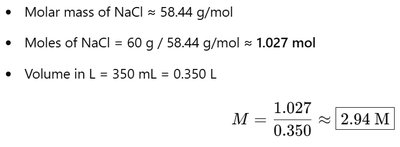
Calculating Mass from Molarity and Volume
Example: 0.60 M KCl, 200 mL:
Moles = mol
Mass = g
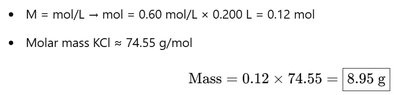
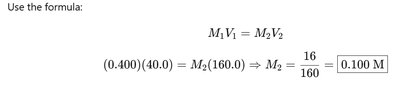
Dilution Calculation Example
Example: Diluting 40.0 mL of 0.400 M CrCl3 to 160.0 mL:
M
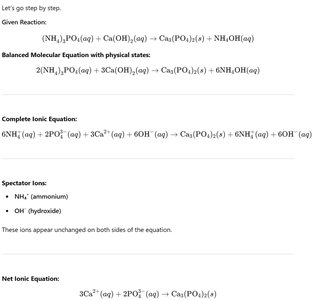
Precipitation Reaction Example
Mixing (NH4)3PO4 and Ca(OH)2:
Balanced Molecular Equation:
Complete Ionic Equation:
Spectator Ions: NH4+, OH-
Net Ionic Equation:
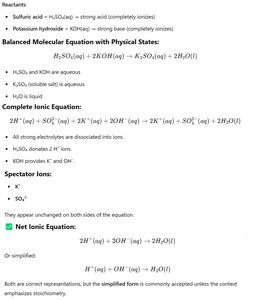
Acid-Base Reaction Example
Mixing H2SO4 and KOH:
Balanced Molecular Equation:
Net Ionic Equation:
Summary Table: Types of Particles in Solution
Compound | Type in Solution |
|---|---|
Fe(OH)3 (weak base) | Both ions and molecules |
HNO3 (strong acid) | Only ions |
Sugar (nonelectrolyte) | Only molecules |
NaCl (strong electrolyte) | Only ions |
Ethanol (nonelectrolyte) | Only molecules |
