Ch. 2 The Chemistry of Life
Amerman - Human Anatomy & Physiology 2nd Edition
Amerman2nd EditionHuman Anatomy & PhysiologyISBN: 9780136873822Not the one you use?Change textbook
Chapter 2, Problem 19

Mark the following properties as belonging to either DNA or RNA.


a. Contains the nucleotides A, G, C, and U _________          
b. Found only in the nucleus of the cell   _________       
c. Can move in and out of the cell's nucleus _________         
d. Contains two strands of nucleotides linked by hydrogen bonds _________          
e. Contains the code for every protein in the body _________          
f. Contains the sugar ribose _________          

Verified step by step guidance
1
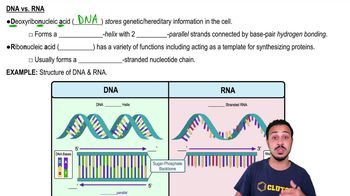
Step 1: Understand the basic differences between DNA and RNA. DNA (Deoxyribonucleic Acid) contains the sugar deoxyribose, has the nucleotides A (adenine), G (guanine), C (cytosine), and T (thymine), and is double-stranded. RNA (Ribonucleic Acid) contains the sugar ribose, has the nucleotides A, G, C, and U (uracil), and is single-stranded.
Step 2: For part (a), identify which molecule contains the nucleotides A, G, C, and U. Recall that uracil (U) is unique to RNA, so this property belongs to RNA.
Step 3: For part (b), determine which molecule is found only in the nucleus. DNA is typically confined to the nucleus in eukaryotic cells, so this property belongs to DNA.
Step 4: For part (c), identify which molecule can move in and out of the nucleus. RNA, specifically mRNA (messenger RNA), is synthesized in the nucleus and then moves to the cytoplasm for protein synthesis, so this property belongs to RNA.
Step 5: For parts (d), (e), and (f), analyze the structural and functional characteristics: (d) DNA is double-stranded, so this property belongs to DNA. (e) DNA contains the complete genetic code for all proteins, so this property belongs to DNA. (f) RNA contains the sugar ribose, so this property belongs to RNA.

Verified video answer for a similar problem:

This video solution was recommended by our tutors as helpful for the problem above.
Was this helpful?

Key Concepts

Here are the essential concepts you must grasp in order to answer the question correctly.

Differences between DNA and RNA

DNA (deoxyribonucleic acid) and RNA (ribonucleic acid) are both nucleic acids but have distinct structures and functions. DNA is typically double-stranded and contains the sugar deoxyribose, while RNA is usually single-stranded and contains ribose. Additionally, DNA uses thymine as a nucleotide base, whereas RNA uses uracil instead.
Recommended video:
05:57
DNA vs. RNA

Nucleotide Composition

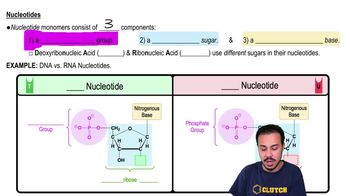
Nucleotides are the building blocks of nucleic acids, consisting of a sugar, a phosphate group, and a nitrogenous base. In RNA, the nitrogenous bases include adenine (A), guanine (G), cytosine (C), and uracil (U). In contrast, DNA contains adenine, guanine, cytosine, and thymine (T). Understanding these compositions is crucial for identifying the properties of each nucleic acid.
Recommended video:
05:35
Nucleotides

Cellular Location and Function

DNA is primarily located in the nucleus of eukaryotic cells, where it serves as the genetic blueprint for the organism. RNA, on the other hand, can be found both in the nucleus and the cytoplasm, playing various roles in protein synthesis and gene expression. This distinction in location and function is essential for understanding the properties listed in the question.
Recommended video:
Guided course
3:55
Locations of Serous Membranes