

Mark the following statements as true or false. If a statement is false, correct it to make a true statement. Cartilaginous joints are synarthroses.
Verified step by step guidance
1
Step 1: Understand the key terms in the problem. 'Cartilaginous joints' are joints where bones are connected by cartilage, and 'synarthroses' are immovable joints. Familiarize yourself with these definitions to assess the statement's accuracy.
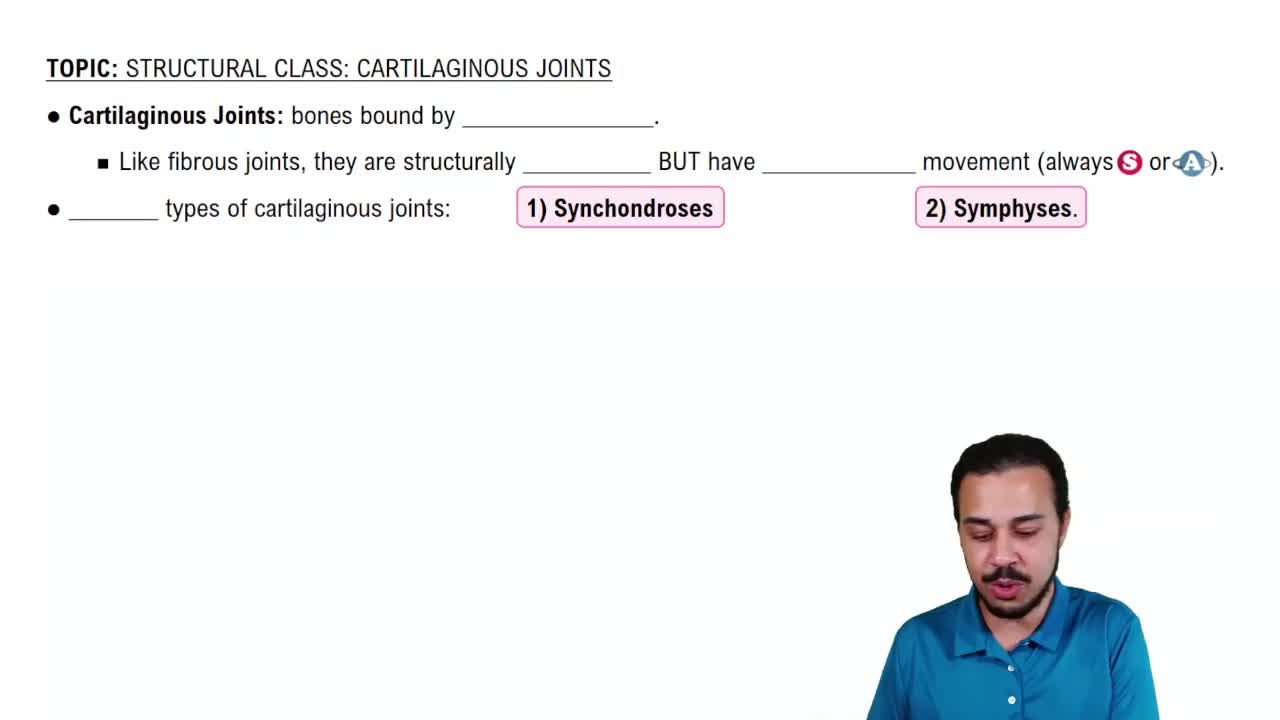
Step 2: Recall the classification of cartilaginous joints. There are two types: synchondroses (which can be immovable, like the epiphyseal plate) and symphyses (which are slightly movable, like the pubic symphysis). This indicates that cartilaginous joints are not exclusively synarthroses.
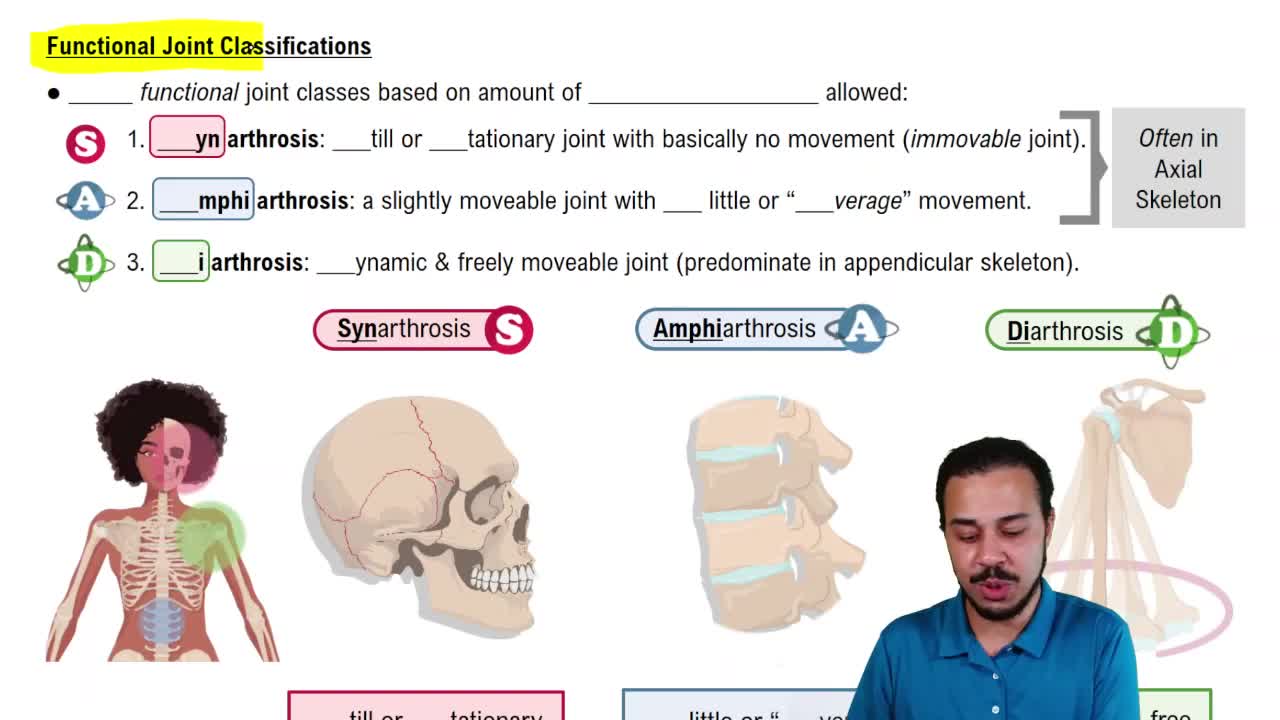
Step 3: Evaluate the statement 'Cartilaginous joints are synarthroses.' Based on the definitions and examples, this statement is false because cartilaginous joints can also be amphiarthroses (slightly movable).
Step 4: Correct the false statement. A true statement would be: 'Cartilaginous joints can be either synarthroses or amphiarthroses, depending on the specific type of joint.'
Step 5: Review the corrected statement and ensure it aligns with anatomical classifications and examples, such as synchondroses being synarthroses and symphyses being amphiarthroses.
Verified video answer for a similar problem:
This video solution was recommended by our tutors as helpful for the problem above
Play a video:
0 Comments
Key Concepts
Here are the essential concepts you must grasp in order to answer the question correctly.
Cartilaginous Joints
Cartilaginous joints are a type of joint where the bones are connected by cartilage. They allow for limited movement and are classified into two types: synchondroses, which are immovable, and symphyses, which allow slight movement. An example of a cartilaginous joint is the pubic symphysis, which connects the left and right pubic bones.
Synarthroses are joints that are immovable. They are typically found in areas where stability is crucial, such as the sutures of the skull. Understanding the classification of joints helps in identifying their functional roles in the body, particularly in relation to movement and stability.
Joints are classified based on their structure and function. The main categories include fibrous, cartilaginous, and synovial joints. Each type has distinct characteristics regarding movement and stability, which is essential for understanding how different joints contribute to overall body mechanics.