
Textbook Question
Mark the following statements as true or false. If a statement is false, correct it to make a true statement.
Cartilaginous joints are synarthroses.
925
views
 Verified step by step guidance
 05:36
05:36
 8:20
8:20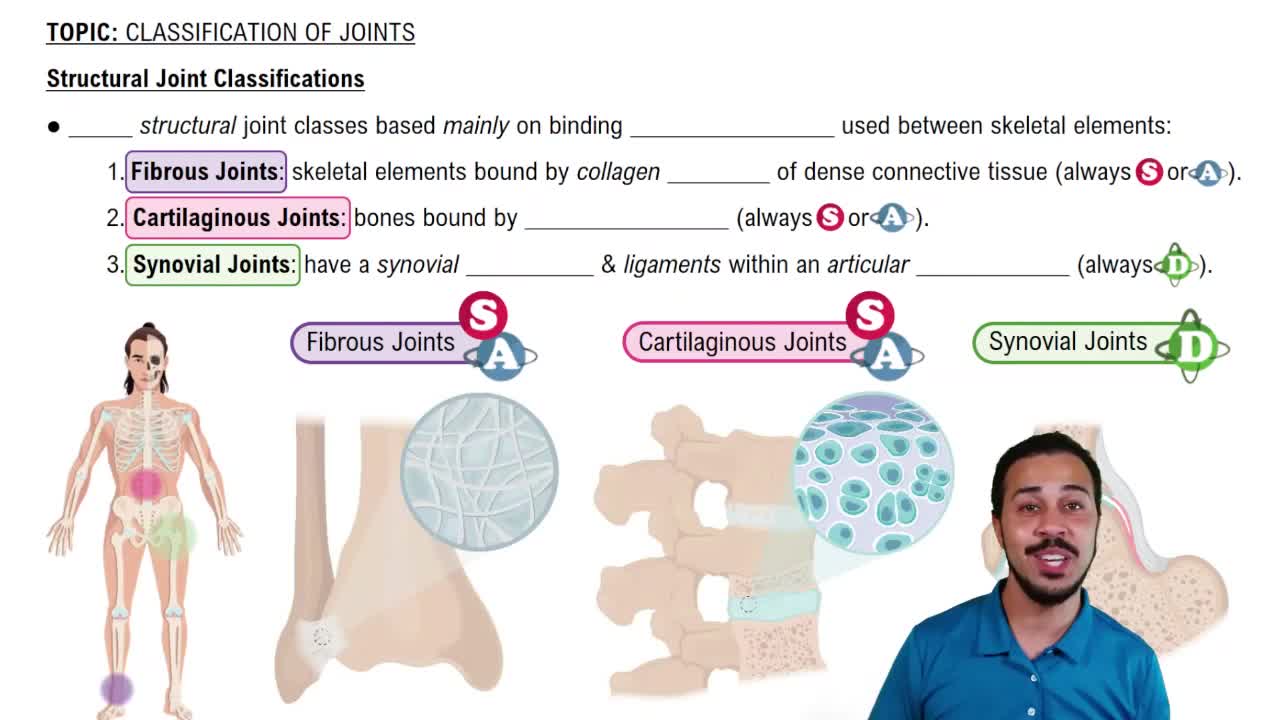 08:25
08:25Mark the following statements as true or false. If a statement is false, correct it to make a true statement.
Cartilaginous joints are synarthroses.
Mark the following statements as true or false. If a statement is false, correct it to make a true statement.
Fibrous joints are united by collagen fibers.
Match the following terms with the correct definition from the right column.
Plane joint
Saddle joint
Ball-and-socket joint
Condylar joint
Pivot joint
Hinge joint
a. Uniaxial joint in which the rounded articular surface of one bone fits into a groove of another bone and is held in place by a ligamentous ring
b. Multiaxial joint in which the spherical articular surface of one bone fits into a cup or socket of another bone
c. Nonaxial joint in which two flat surfaces glide over each other
d. Uniaxial joint in which the convex articular surface of one bone fits into a concave articular depression
e. Biaxial joint in which the oval, convex articulating surface of one bone fits into the shallow depression of another bone
f. Biaxial joint in which each articular surface has both convex and concave regions
Mark the following statements as true or false. If a statement is false, correct it to make a true statement.
A syndesmosis is a type of cartilaginous joint.
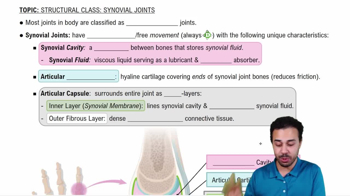
What is/are the function(s) of synovial fluid?
Which of the following correctly describes the function of a ligament?
a. It connects a muscle to its attachment point, such as a bone.
b. It is a fluid-filled structure that minimizes friction during movement.
c. It connects two bones to each other in a joint.
d. It surrounds a tendon and protects it in high-stress areas.