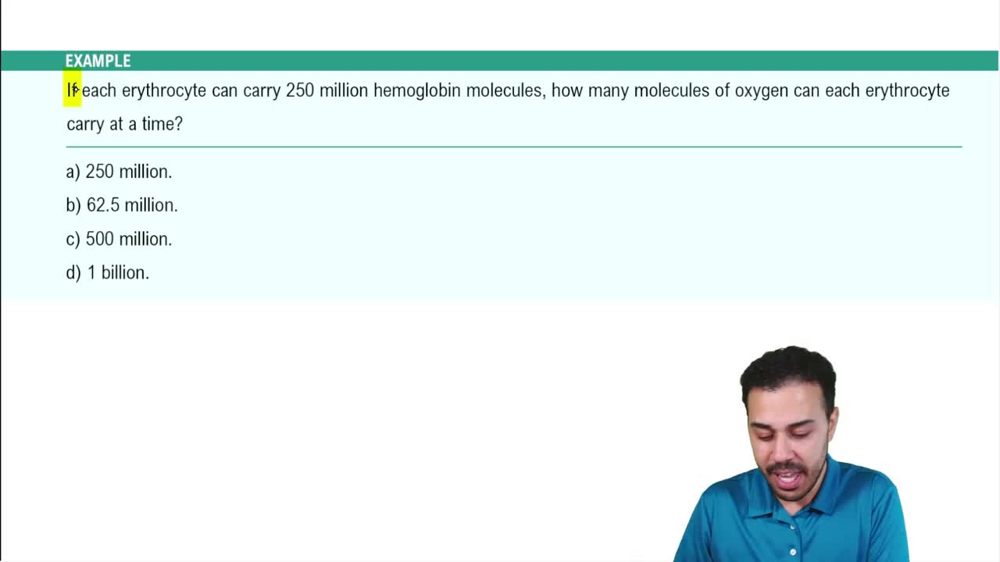
Erythropoietin directly stimulates RBC formation by: (a) Increasing rates of mitotic divisions in erythroblasts (b) Speeding up the maturation of red blood cells (c) Accelerating the rate of hemoglobin synthesis (d) All of these
Verified step by step guidance
1
Step 1: Understand the role of erythropoietin (EPO) in red blood cell (RBC) formation. EPO is a hormone primarily produced by the kidneys in response to low oxygen levels in the blood.
Step 2: Recognize that erythropoietin acts on erythroblasts, which are immature red blood cell precursors in the bone marrow, to stimulate their proliferation and differentiation.
Step 3: Identify the specific effects of erythropoietin on erythroblasts: it increases the rate of mitotic divisions (cell division), speeds up the maturation process of these cells into mature RBCs, and accelerates hemoglobin synthesis within these cells.
Step 4: Since erythropoietin influences all these processes—mitotic division, maturation speed, and hemoglobin production—it directly stimulates RBC formation through multiple mechanisms.
Step 5: Conclude that the correct answer is the option that includes all these effects, reflecting the comprehensive role of erythropoietin in RBC production.
Verified video answer for a similar problem:
This video solution was recommended by our tutors as helpful for the problem above
Play a video:
0 Comments
Key Concepts
Here are the essential concepts you must grasp in order to answer the question correctly.
Erythropoietin (EPO) Function
Erythropoietin is a hormone primarily produced by the kidneys that regulates red blood cell (RBC) production. It responds to low oxygen levels by stimulating the bone marrow to increase RBC formation, ensuring adequate oxygen transport in the blood.
Erythroblasts are immature red blood cells in the bone marrow. Erythropoietin promotes their mitotic division, increasing their numbers, and accelerates their maturation process, allowing them to develop into functional RBCs more quickly.
Hemoglobin is the oxygen-carrying protein in red blood cells. During erythropoiesis, erythropoietin enhances the synthesis of hemoglobin within developing erythroblasts, ensuring that mature RBCs can efficiently transport oxygen throughout the body.