Discuss hemoglobin relative to its chemical structure, its function, and the color changes it undergoes during loading and unloading of oxygen.
Verified step by step guidance
1
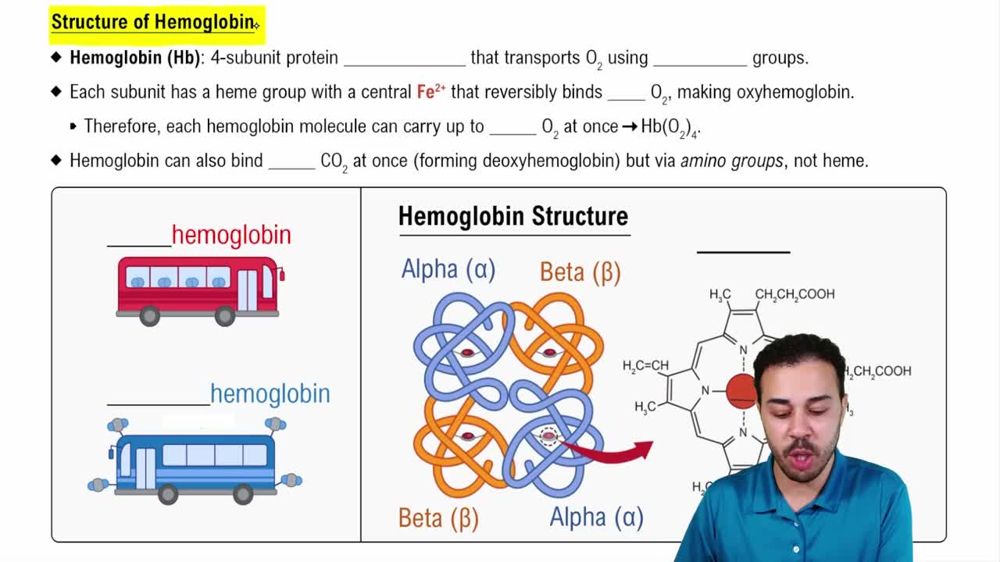
Start by describing the chemical structure of hemoglobin: it is a protein composed of four polypeptide chains (two alpha and two beta chains), each containing a heme group with an iron (Fe2+) atom at its center, which is essential for oxygen binding.
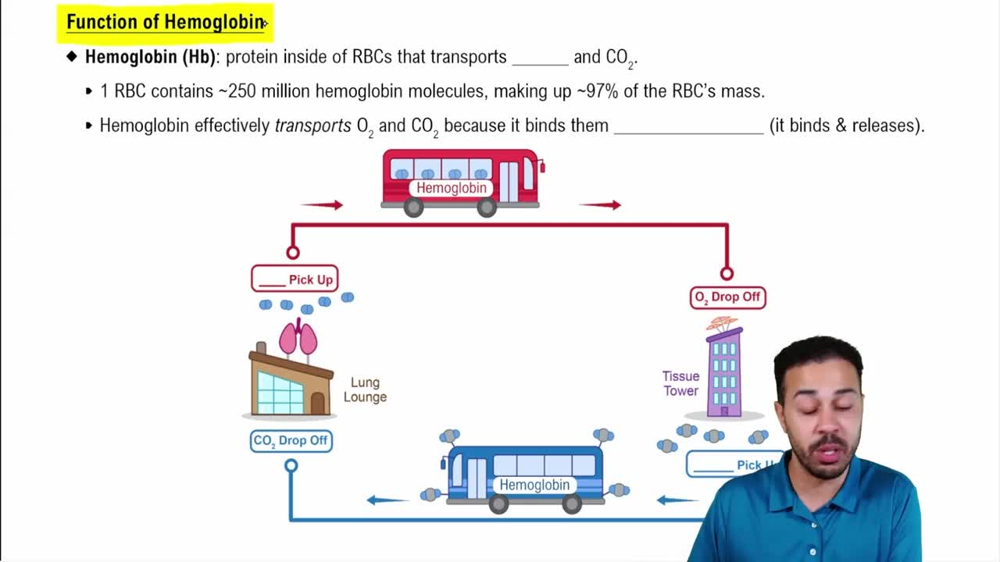
Explain the primary function of hemoglobin, which is to transport oxygen from the lungs to the tissues and facilitate the return transport of carbon dioxide from tissues to the lungs.
Discuss how oxygen binds reversibly to the iron atom in the heme group, allowing hemoglobin to pick up oxygen in the lungs (loading) and release it in the tissues (unloading).
Describe the color changes associated with hemoglobin: when oxygen is bound (oxyhemoglobin), the blood appears bright red; when oxygen is released (deoxyhemoglobin), the blood takes on a darker, bluish-red color.
Conclude by noting that these color changes are due to conformational changes in the hemoglobin molecule and the different light absorption properties of oxyhemoglobin versus deoxyhemoglobin.
Verified video answer for a similar problem:
This video solution was recommended by our tutors as helpful for the problem above
Video duration:
2m
Play a video:
0 Comments
Key Concepts
Here are the essential concepts you must grasp in order to answer the question correctly.
Chemical Structure of Hemoglobin
Hemoglobin is a protein composed of four polypeptide chains, each containing a heme group with an iron atom. This iron binds oxygen molecules, enabling hemoglobin to carry oxygen in the blood. The quaternary structure allows cooperative binding, meaning oxygen binding to one subunit increases affinity in others.
Hemoglobin's primary function is to transport oxygen from the lungs to tissues and facilitate carbon dioxide return to the lungs. It binds oxygen in high-oxygen environments and releases it where oxygen is low, supporting cellular respiration and energy production.
Hemoglobin changes color based on its oxygenation state: oxygenated hemoglobin appears bright red due to oxygen binding, while deoxygenated hemoglobin is darker, giving venous blood a bluish tint. These color changes reflect structural shifts in the heme group during oxygen loading and unloading.

 2:34 minutes
 Verified step by step guidance
 6:45
6:45