Your friend argues that all water conducts electricity, regardless of what it contains. You prepare three liquids to test this hypothesis: one with distilled water (with no solutes, only water molecules), one with 5% glucose in distilled water, and one with 5% sodium chloride in water. Which of these solutions, if any, will conduct an electric current? Explain.
Verified step by step guidance
1
Step 1: Begin by understanding the concept of electrical conductivity in liquids. Electrical conductivity depends on the presence of charged particles (ions) in the solution. Pure water (distilled water) has very few ions and is a poor conductor of electricity.
Step 2: Analyze the first solution, distilled water. Since distilled water contains only water molecules and no dissolved ions, it will not conduct electricity effectively.
Step 3: Examine the second solution, 5% glucose in distilled water. Glucose is a covalent compound and does not dissociate into ions when dissolved in water. Therefore, this solution will also not conduct electricity.
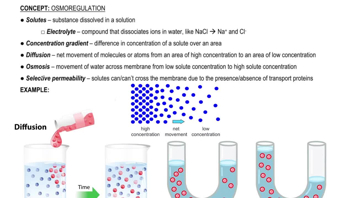
Step 4: Evaluate the third solution, 5% sodium chloride in water. Sodium chloride (NaCl) is an ionic compound that dissociates into sodium (Na⁺) and chloride (Cl⁻) ions when dissolved in water. These ions allow the solution to conduct electricity.
Step 5: Conclude that the solution containing sodium chloride will conduct electricity due to the presence of free ions, while the solutions with distilled water and glucose will not conduct electricity because they lack free ions.
Verified video answer for a similar problem:
This video solution was recommended by our tutors as helpful for the problem above
Play a video:
0 Comments
Key Concepts
Here are the essential concepts you must grasp in order to answer the question correctly.
Electrical Conductivity
Electrical conductivity refers to the ability of a substance to conduct electric current. This property is influenced by the presence of charged particles, such as ions, which can move freely within the solution. Pure distilled water has very few ions and thus has low conductivity, while solutions containing electrolytes, like sodium chloride, have higher conductivity due to the dissociation of the salt into ions.
Electrical Conduction System of the Heart Example 2
Electrolytes
Electrolytes are substances that dissociate into ions when dissolved in water, allowing the solution to conduct electricity. Common examples include salts, acids, and bases. In the context of the question, sodium chloride (NaCl) is a strong electrolyte that fully dissociates into sodium (Na+) and chloride (Cl-) ions, enhancing the solution's ability to conduct electric current, while glucose does not dissociate into ions and therefore does not contribute to conductivity.
Solute concentration refers to the amount of solute present in a given volume of solvent. In this experiment, the concentration of sodium chloride and glucose in the solutions affects their conductivity. A higher concentration of electrolytes typically results in greater conductivity, as more ions are available to carry the electric current. In contrast, distilled water, having no solutes, will not conduct electricity effectively.