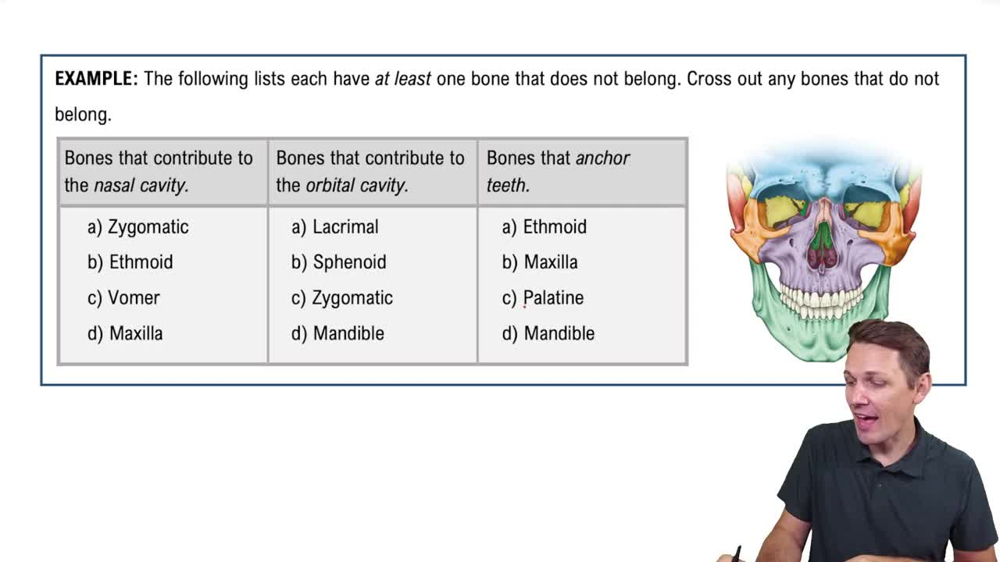
a. Maxilla b. Lacrimal bone c. Mandible d. Frontal bone
Verified step by step guidance
1
Step 1: Understand the anatomy of the adult skull. The human skull is composed of several bones, most of which are fused together and immovable. However, there is one bone that is moveable and plays a key role in functions like chewing and speaking.
Step 2: Review the function and location of each option provided in the question: a) Maxilla, b) Lacrimal bone, c) Mandible, and d) Frontal bone.
Step 3: Recall that the maxilla is the upper jawbone and is fused to the skull, making it immovable. The lacrimal bone is a small bone in the medial wall of the orbit and is also immovable. The frontal bone forms the forehead and is fused to the skull as well.
Step 4: Identify the mandible as the lower jawbone, which is connected to the skull via the temporomandibular joint (TMJ). This joint allows the mandible to move, making it the only moveable bone in the adult skull.
Step 5: Conclude that the correct answer is the mandible, as it is the only bone in the adult skull that is moveable due to its articulation with the temporal bone at the TMJ.
Verified video answer for a similar problem:
This video solution was recommended by our tutors as helpful for the problem above
Play a video:
0 Comments
Key Concepts
Here are the essential concepts you must grasp in order to answer the question correctly.
Anatomy of the Skull
The human skull is composed of two main parts: the cranial bones, which protect the brain, and the facial bones, which form the structure of the face. Most skull bones are fused together and immovable, except for one key bone that allows for movement.
The mandible, or lower jawbone, is the only moveable bone in the adult skull. It connects to the temporal bone at the temporomandibular joint, allowing for essential functions such as chewing and speaking.
Skull bones can be categorized into cranial bones, which encase the brain, and facial bones, which support the face. Understanding these categories helps in identifying which bones are movable and which are fixed, highlighting the unique role of the mandible.