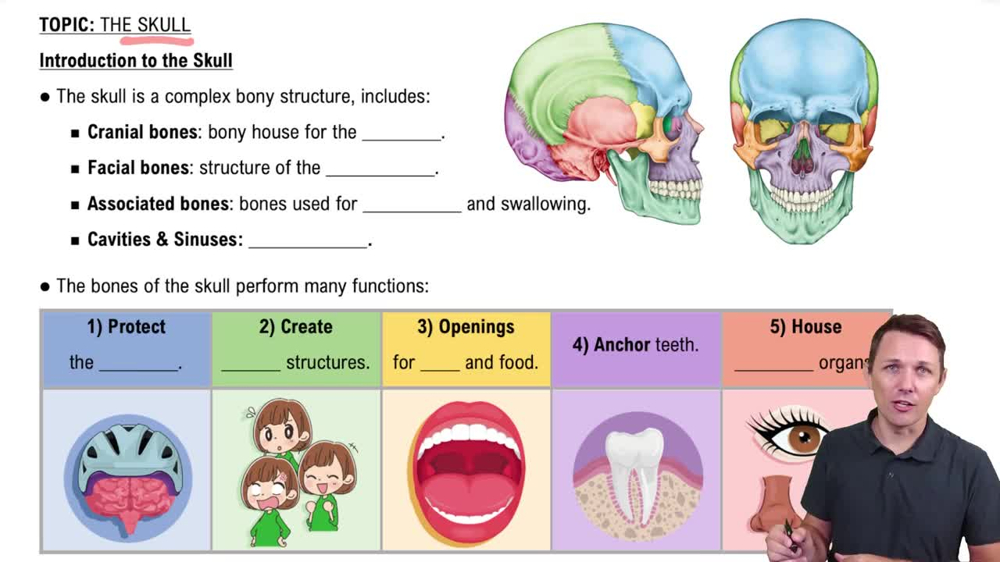
How do the relative proportions of the cranium and face of a fetus compare with those of an adult skull?
Verified step by step guidance
1
Step 1: Understand the basic anatomy of the skull, which is divided into two main parts: the cranium (which houses the brain) and the face (which includes the jaw, nose, and other facial bones).
Step 2: Recognize that during fetal development, the cranium is proportionally much larger compared to the face because the brain grows rapidly and requires more space early on.
Step 3: Note that in a fetus, the face is relatively small and underdeveloped compared to the cranium, reflecting the priority of brain growth over facial bone growth at this stage.
Step 4: Contrast this with the adult skull, where the face has grown significantly and the proportions between the cranium and face are more balanced, with the face being larger relative to the cranium than in the fetus.
Step 5: Summarize that the relative proportion of the cranium to the face decreases from fetus to adult, meaning the cranium is larger relative to the face in the fetus, while in adults, the face is proportionally larger compared to the cranium.
Verified video answer for a similar problem:
This video solution was recommended by our tutors as helpful for the problem above
Video duration:
2m
Play a video:
0 Comments
Key Concepts
Here are the essential concepts you must grasp in order to answer the question correctly.
Cranial and Facial Proportions in Fetal Development
In fetal development, the cranium is proportionally larger compared to the face, reflecting early brain growth. This results in a relatively large forehead and small facial bones. Understanding this helps explain the distinct skull shape differences between fetuses and adults.
After birth, the face grows more rapidly than the cranium, especially during childhood and adolescence. This differential growth changes the relative proportions, making the adult skull have a larger face relative to the cranium compared to the fetal skull.
Functional and Evolutionary Implications of Skull Proportions
The larger fetal cranium accommodates rapid brain development, while the smaller face reflects less developed jaws and sensory structures. In adults, increased facial size supports functions like mastication and respiration, illustrating how skull proportions relate to developmental and functional needs.

 2:56 minutes
 Verified step by step guidance
 4:36
4:36