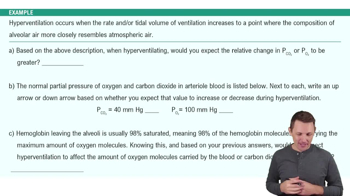
You and a friend are having a contest to see who can hold his or her breath the longest. Your friend hyperventilates before holding his breath, and subsequently wins the contest. Why did hyperventilation give him an advantage?
Verified step by step guidance
1
Understand the concept of hyperventilation: Hyperventilation is a process where a person breathes rapidly and deeply, expelling more carbon dioxide (CO2) from the body than usual. This reduces the concentration of CO2 in the blood, leading to a temporary state of respiratory alkalosis (increased blood pH).
Recognize the role of CO2 in the urge to breathe: The primary driver for the urge to breathe is the buildup of CO2 in the blood, not the lack of oxygen (O2). As CO2 levels rise, chemoreceptors in the brain and blood vessels signal the respiratory centers to initiate breathing.
Explain the effect of hyperventilation on CO2 levels: By hyperventilating, your friend reduced the baseline level of CO2 in their blood. This means it would take longer for CO2 to accumulate to the threshold level that triggers the urge to breathe.
Connect this to the contest: Since your friend started with lower CO2 levels, they were able to hold their breath longer before reaching the point where the urge to breathe became overwhelming. This gave them an advantage in the contest.
Discuss potential risks: While hyperventilation can temporarily extend breath-holding ability, it can also lead to dizziness, fainting, or reduced oxygen delivery to tissues due to the Bohr effect. This is why it should be done cautiously and not encouraged in unsafe environments.
Verified video answer for a similar problem:
This video solution was recommended by our tutors as helpful for the problem above
Play a video:
0 Comments
Key Concepts
Here are the essential concepts you must grasp in order to answer the question correctly.
Hyperventilation
Hyperventilation is a condition where a person breathes at an abnormally rapid rate, leading to a decrease in carbon dioxide (CO2) levels in the blood. This can result in respiratory alkalosis, which temporarily increases the blood's pH. By hyperventilating, your friend reduces the urge to breathe, allowing him to hold his breath longer before the body's natural reflex to inhale kicks in.
Carbon dioxide plays a crucial role in regulating the body's urge to breathe. As CO2 levels rise in the blood, it triggers the respiratory center in the brain to initiate breathing. By hyperventilating, your friend lowers his CO2 levels, delaying this urge and enabling him to hold his breath for a more extended period before the body signals the need to breathe.
Holding one's breath leads to a gradual decrease in oxygen levels and an increase in carbon dioxide levels in the body. Individuals can develop varying tolerances to these changes. Your friend's hyperventilation may have allowed him to start with a higher oxygen reserve, giving him a temporary advantage in the contest by prolonging the time before he experiences significant oxygen deprivation.