
Henry's law states that the degree to which a gas dissolves in a liquid is determined by its: a. Partial pressure b. Solubility c. Surface tension d. Both a and b are correct e. All of the above are correct
Verified step by step guidance
1
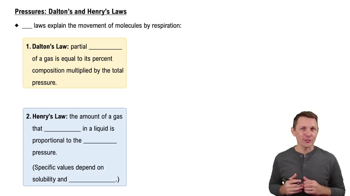
Understand the concept of Henry's law: It states that the amount of gas that dissolves in a liquid is directly proportional to the partial pressure of the gas above the liquid and its solubility in the liquid.
Analyze the options provided: Option (a) refers to partial pressure, which is a key factor in Henry's law. Option (b) refers to solubility, which is also a key factor. Option (c) refers to surface tension, which is unrelated to Henry's law.
Evaluate option (d): 'Both a and b are correct' aligns with the principles of Henry's law, as both partial pressure and solubility are critical factors.
Evaluate option (e): 'All of the above are correct' is incorrect because surface tension (option c) is not relevant to Henry's law.
Conclude that the correct answer is option (d), as it accurately reflects the two factors (partial pressure and solubility) that determine gas dissolution according to Henry's law.
Verified video answer for a similar problem:
This video solution was recommended by our tutors as helpful for the problem above
Play a video:
0 Comments
Key Concepts
Here are the essential concepts you must grasp in order to answer the question correctly.
Henry's Law
Henry's Law describes the relationship between the solubility of a gas in a liquid and the partial pressure of that gas above the liquid. It states that at a constant temperature, the amount of gas that dissolves in a liquid is directly proportional to the partial pressure of that gas. This principle is crucial for understanding how gases behave in solutions, particularly in fields like chemistry and environmental science.
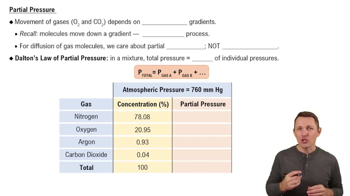
Partial pressure refers to the pressure exerted by a single component of a mixture of gases. In the context of Henry's Law, it is the pressure of the gas above the liquid that influences how much of that gas will dissolve in the liquid. Understanding partial pressure is essential for predicting gas solubility and is widely applied in various scientific and industrial processes.
Solubility is the maximum amount of a substance (solute) that can dissolve in a given amount of solvent at a specific temperature and pressure. It is a key factor in determining how gases dissolve in liquids, as different gases have different solubility levels. Recognizing the factors that affect solubility, including temperature and the nature of the solute and solvent, is vital for applications in chemistry and biology.