Understand that anatomy and physiology are two closely related fields of study within biology and medicine, focusing on the human body.
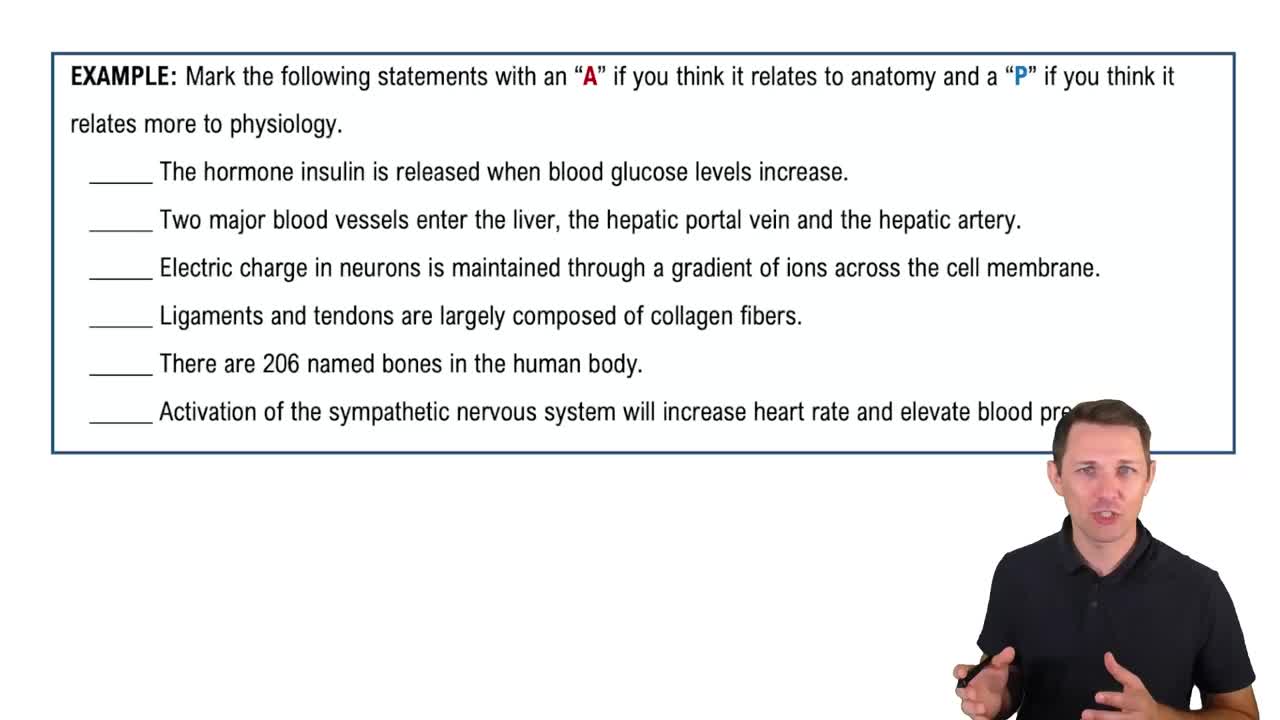
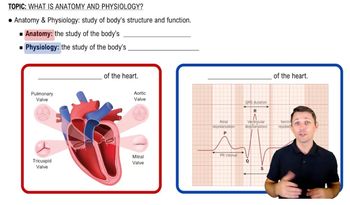
Define anatomy: Anatomy is the study of the structure of the body and its parts. It involves examining the physical organization, such as organs, tissues, and systems, and how they are arranged within the body.
Define physiology: Physiology is the study of the function of the body and its parts. It explores how organs, tissues, and systems work individually and together to maintain life and homeostasis.
Recognize the relationship between anatomy and physiology: Anatomy provides the structural framework, while physiology explains how those structures function. For example, understanding the anatomy of the heart helps explain its physiological role in pumping blood.
Consider examples to reinforce understanding: For instance, studying the anatomy of the lungs involves identifying their structure (bronchi, alveoli, etc.), while studying their physiology involves understanding how gas exchange occurs during respiration.
Verified video answer for a similar problem:
This video solution was recommended by our tutors as helpful for the problem above
Video duration:
1m
Play a video:
Was this helpful?
Key Concepts
Here are the essential concepts you must grasp in order to answer the question correctly.
Anatomy
Anatomy is the branch of biology that studies the structure and organization of living organisms. It involves examining the physical components of the body, including organs, tissues, and cells, and how they relate to one another. Anatomy can be divided into various subfields, such as gross anatomy, which looks at structures visible to the naked eye, and microscopic anatomy, which focuses on structures at the cellular level.
Physiology is the scientific study of the functions and processes of living organisms and their parts. It explores how various systems within the body operate, interact, and maintain homeostasis. This field encompasses various levels of organization, from cellular processes to the functioning of entire organ systems, and is essential for understanding how the body responds to internal and external changes.
Anatomy and physiology are closely interconnected, as the structure of an organism (anatomy) directly influences its function (physiology). Understanding the anatomical layout of organs and systems is crucial for comprehending how they work together to sustain life. For example, the structure of the heart (anatomy) is designed to facilitate its role in pumping blood (physiology), illustrating the importance of studying both fields in tandem.