
The following is a list of six levels of organization that make up the human body: (1) Tissue (2) Cell (3) Organ (4) Chemical (5) Organism (6) Organ system The correct order, from the simplest to the most complex level, is (a) 2, 4, 1, 3, 6, 5 (b) 4, 2, 1, 3, 6, 5 (c) 4, 2, 1, 6, 3, 5 (d) 4, 2, 3, 1, 6, 5 (e) 2, 1, 4, 3, 5, 6
Verified step by step guidance
1
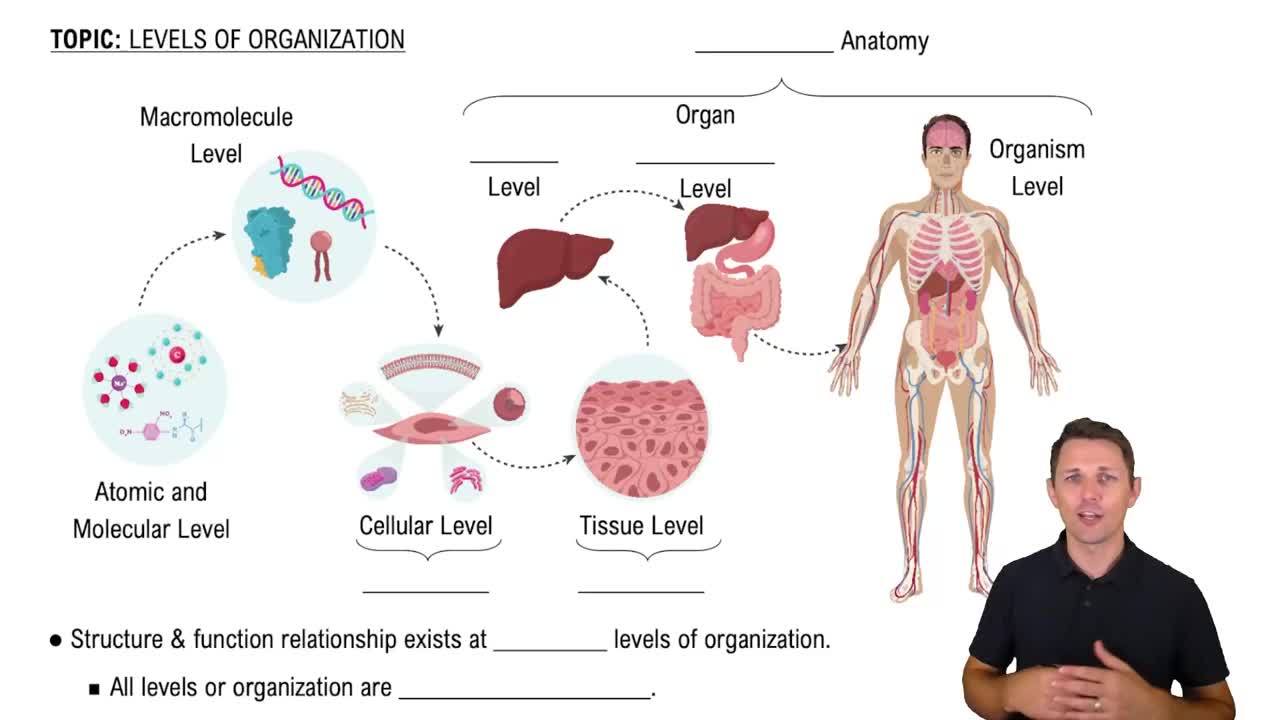
Step 1: Understand the levels of organization in the human body, which range from the simplest to the most complex. The typical hierarchy is Chemical, Cell, Tissue, Organ, Organ System, and Organism.
Step 2: Identify each level from the list given: (4) Chemical, (2) Cell, (1) Tissue, (3) Organ, (6) Organ system, and (5) Organism.
Step 3: Arrange these levels starting with the Chemical level, which includes atoms and molecules, as the simplest building blocks.
Step 4: Next is the Cell level, where molecules combine to form cells, the basic unit of life.
Step 5: Then comes Tissue (groups of similar cells), followed by Organ (structures made of tissues), Organ System (groups of organs working together), and finally Organism (the complete living being).
Verified video answer for a similar problem:
This video solution was recommended by our tutors as helpful for the problem above
Video duration:
3m
Play a video:
0 Comments
Key Concepts
Here are the essential concepts you must grasp in order to answer the question correctly.
Levels of Biological Organization
Biological organization refers to the hierarchy of complex biological structures and systems that define life, starting from the simplest chemical level to the complete organism. Understanding this hierarchy helps in grasping how smaller units combine to form larger, more complex structures.
The chemical level includes atoms and molecules essential for life, while the cellular level is the basic unit of life where molecules combine to form cells. Recognizing that chemicals form cells is crucial for ordering these levels correctly.
Cells group to form tissues, tissues combine to create organs, organs work together in organ systems, and organ systems collectively make up an organism. This progression from simple to complex structures is key to understanding the correct sequence.