Ch. 29 Development and Inheritance
Martini - Fundamentals of Anatomy & Physiology 11th Edition
Martini, Nath, Bartholomew11th EditionFundamentals of Anatomy & PhysiologyISBN: 9780136874089Not the one you use?Change textbook
Chapter 28, Problem 24b

Indicate the type of inheritance involved in each of the following situations. 
(b) Children exhibit the trait even though neither parent does. 

Verified step by step guidance
1
Understand the concept of inheritance: Inheritance refers to the transmission of genetic traits from parents to offspring. Traits can be inherited in different patterns, such as autosomal dominant, autosomal recessive, X-linked, or mitochondrial inheritance.
Analyze the situation: The problem states that children exhibit the trait even though neither parent does. This suggests that the trait is not expressed in the parents but appears in the offspring.
Recall the characteristics of autosomal recessive inheritance: In autosomal recessive inheritance, a trait is expressed only when an individual inherits two copies of the recessive allele (one from each parent). Parents who do not exhibit the trait may be carriers, meaning they possess one recessive allele but do not express the trait themselves.
Consider the genetic mechanism: For the children to exhibit the trait, both parents must contribute a recessive allele. This means the parents are heterozygous carriers (having one dominant and one recessive allele). When both parents pass on the recessive allele, the child inherits two recessive alleles and expresses the trait.
Conclude the type of inheritance: Based on the analysis, the type of inheritance involved in this situation is autosomal recessive inheritance.

Verified video answer for a similar problem:

This video solution was recommended by our tutors as helpful for the problem above.
Was this helpful?

Key Concepts

Here are the essential concepts you must grasp in order to answer the question correctly.

Recessive Inheritance

Recessive inheritance occurs when a trait is expressed only when an individual has two copies of the recessive allele, one from each parent. In the scenario where children exhibit a trait that neither parent shows, it suggests that both parents are carriers of a recessive allele. This means they possess one dominant allele that masks the recessive trait, but they can still pass the recessive allele to their offspring.
Recommended video:
07:23
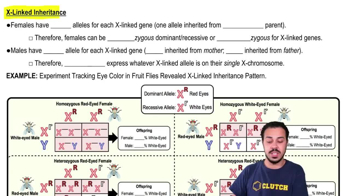
X-Linked Inheritance

Carrier Parents

Carrier parents are individuals who have one copy of a recessive allele and one copy of a dominant allele for a particular trait. They do not express the trait themselves but can pass the recessive allele to their children. In the given situation, both parents could be carriers, leading to the possibility of their children inheriting two recessive alleles and thus expressing the trait.
Recommended video:
05:22
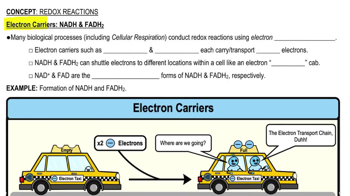
Electron Carriers: NADH & FADH2

Punnett Square

A Punnett square is a diagram used to predict the genetic makeup of offspring from a cross between two parents. It helps visualize the combinations of alleles that can result from the mating of two individuals. In this case, using a Punnett square can illustrate how two carrier parents can produce offspring that exhibit a recessive trait, despite neither parent showing it.
Recommended video:
07:23
X-Linked Inheritance