Ch. 29 Development and Inheritance
Martini - Fundamentals of Anatomy & Physiology 11th Edition
Martini, Nath, Bartholomew11th EditionFundamentals of Anatomy & PhysiologyISBN: 9780136874089Not the one you use?Change textbook
Chapter 28, Problem 23b

Distinguish between the following paired terms: 
(b) heterozygous and homozygous, 

Verified step by step guidance
1
Step 1: Understand that both terms, heterozygous and homozygous, relate to the genetic makeup (genotype) of an organism at a specific gene locus.
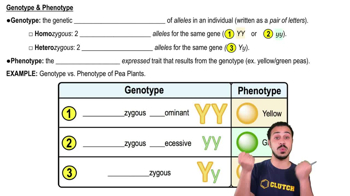
Step 2: Define homozygous as having two identical alleles for a particular gene. This means both copies of the gene inherited from each parent are the same (e.g., AA or aa).
Step 3: Define heterozygous as having two different alleles for a particular gene. This means the two gene copies inherited from each parent differ (e.g., Aa).
Step 4: Recognize that these differences in alleles can affect the organism's traits (phenotype), depending on whether the alleles are dominant or recessive.
Step 5: Summarize by contrasting the two: homozygous means identical alleles at a gene locus, while heterozygous means different alleles at that locus.

Verified video answer for a similar problem:

This video solution was recommended by our tutors as helpful for the problem above.
Was this helpful?

Key Concepts

Here are the essential concepts you must grasp in order to answer the question correctly.

Homozygous

Homozygous refers to having two identical alleles for a specific gene on both homologous chromosomes. This means the organism inherits the same version of a gene from each parent, resulting in a uniform genetic expression for that trait.
Recommended video:
06:36
Genotype & Phenotype

Heterozygous

Heterozygous describes having two different alleles for a particular gene on homologous chromosomes. This genetic variation can lead to dominant-recessive interactions, where one allele may mask the expression of the other.
Recommended video:
06:36
Genotype & Phenotype

Alleles and Gene Expression

Alleles are different forms of a gene that determine specific traits. Understanding how alleles interact—whether identical or different—is essential to grasping the concepts of homozygosity and heterozygosity, as these interactions influence an organism's phenotype.
Recommended video:
08:44
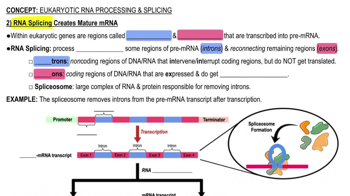
2) RNA Splicing Creates Mature mRNA