Damage to the renal medulla would interfere first with the functioning of the a. Glomerular capsules b. Distal convoluted tubules c. Collecting ducts d. Proximal convoluted tubules
Verified step by step guidance
1
Step 1: Understand the anatomy of the kidney, focusing on the location of the renal cortex and renal medulla. The renal cortex is the outer region, while the renal medulla is the inner region of the kidney.
Step 2: Identify which nephron structures are located primarily in the renal cortex and which are located in the renal medulla. For example, the glomerular capsules, proximal convoluted tubules, and distal convoluted tubules are mostly in the cortex, while the collecting ducts extend into the medulla.
Step 3: Recognize that damage to the renal medulla would first affect structures located within or passing through the medulla, such as the collecting ducts.
Step 4: Eliminate options that correspond to structures located mainly in the cortex (glomerular capsules, proximal and distal convoluted tubules) since they would be less affected initially by medullary damage.
Step 5: Conclude that the collecting ducts, which are located in the medulla and responsible for collecting urine from nephrons, would be the first to have their function interfered with by damage to the renal medulla.
Verified video answer for a similar problem:
This video solution was recommended by our tutors as helpful for the problem above
Video duration:
2m
Play a video:
0 Comments
Key Concepts
Here are the essential concepts you must grasp in order to answer the question correctly.
Renal Medulla Structure and Function
The renal medulla is the innermost part of the kidney, containing structures like the loops of Henle and collecting ducts. It plays a key role in concentrating urine by creating a gradient for water reabsorption. Damage here primarily affects components located within this region.
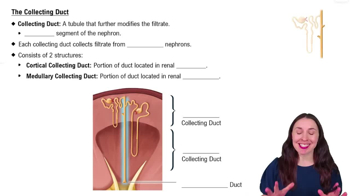
Collecting ducts are tubules located in the renal medulla that receive urine from multiple nephrons. They regulate water and electrolyte balance by reabsorbing water under hormonal control, making them essential for urine concentration and volume regulation.
The renal cortex contains structures like the glomerular capsules and proximal/distal convoluted tubules, while the medulla contains loops of Henle and collecting ducts. Understanding this spatial organization helps identify which structures are affected by damage to specific kidney regions.