
Ch. 3 The Cell
Amerman - Human Anatomy & Physiology 2nd Edition
Amerman2nd EditionHuman Anatomy & PhysiologyISBN: 9780136873822Not the one you use?Change textbook
Chapter 3, Problem 4

Which of the following best describes the arrangement of the main component of the plasma membrane?
a. A monolayer of phospholipids with the phosphate heads facing the cytosol and the fatty acid tails facing the extracellular fluid
b. A bilayer of phospholipids with the phosphate heads facing the cytosol and extracellular fluid, and the fatty acid tails facing one another
c. A bilayer of phospholipids with the phosphate heads of one layer facing the fatty acid tails of the other
d. A bilayer of phospholipids with a layer of triglycerides sandwiched in the middle

Verified step by step guidance
1
Understand the structure of the plasma membrane: The plasma membrane is primarily composed of a phospholipid bilayer, which is crucial for its function as a selective barrier.
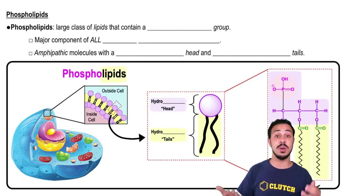
Recall the structure of a phospholipid: Each phospholipid molecule has a hydrophilic (water-attracting) phosphate head and two hydrophobic (water-repelling) fatty acid tails.
Visualize the arrangement of the bilayer: In the plasma membrane, the hydrophilic phosphate heads face outward toward the aqueous environments (cytosol inside the cell and extracellular fluid outside the cell), while the hydrophobic fatty acid tails face inward, away from water, and toward each other.
Eliminate incorrect options: a monolayer (option a) does not describe the plasma membrane, and a bilayer with phosphate heads facing fatty acid tails (option c) or a layer of triglycerides in the middle (option d) are not accurate representations of the plasma membrane structure.
Select the correct description: The correct answer is the bilayer of phospholipids with the phosphate heads facing the cytosol and extracellular fluid, and the fatty acid tails facing one another (option b).

Verified video answer for a similar problem:

This video solution was recommended by our tutors as helpful for the problem above.
Was this helpful?

Key Concepts

Here are the essential concepts you must grasp in order to answer the question correctly.

Phospholipid Bilayer

The phospholipid bilayer is a fundamental structure of the plasma membrane, consisting of two layers of phospholipids. Each phospholipid molecule has a hydrophilic (water-attracting) 'head' and two hydrophobic (water-repelling) 'tails.' In the bilayer, the heads face outward towards the aqueous environments inside and outside the cell, while the tails face inward, away from water, creating a semi-permeable barrier.
Recommended video:
04:05
Phospholipids

Fluid Mosaic Model

The fluid mosaic model describes the plasma membrane's structure, emphasizing its dynamic nature. It suggests that the membrane is not a rigid structure but rather a fluid combination of various lipids and proteins that can move laterally within the layer. This model accounts for the diverse functions of membrane proteins and the flexibility of the membrane, allowing for processes like cell signaling and transport.
Recommended video:
Guided course
3:33
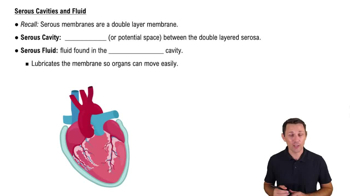
Serous Cavity and Fluid

Membrane Composition and Function

The composition of the plasma membrane, primarily made up of phospholipids, cholesterol, and proteins, is crucial for its function. The arrangement of these components affects membrane fluidity, stability, and the ability to facilitate transport and communication between the cell and its environment. Understanding this composition helps explain how substances move across the membrane and how cells interact with their surroundings.
Recommended video:
03:54
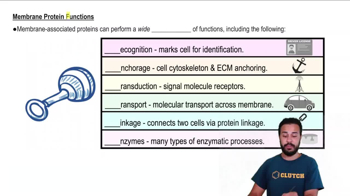
Membrane Protein Functions
Related Practice
Textbook Question

Match the following terms with the correct functions.

_____Peroxisome    

_____Ribosome    

_____Smooth endoplasmic reticulum    

_____Mitochondrion    

_____Golgi apparatus    

_____Lysosome    

_____Rough endoplasmic reticulum     

_____Vesicle


a. Modifies and folds proteins into the correct structure

b. Modifies, packages, and sorts proteins

c. Contains digestive enzymes

d. Granular organelle that makes proteins

e. Synthesizes most of a cell's ATP

f. Contains enzymes that oxidize toxins and fatty acids

g. Membrane-enclosed structure used to transport substances through the cell

h. Detoxifies certain chemicals, makes lipids, stores calcium ions

604
views
Textbook Question

Mark the following statements about the plasma membrane as true or false. If a statement is false, correct it to make a true statement.

Integral membrane proteins generally span the width of the plasma membrane, whereas peripheral proteins are found on only one side of the membrane.

778
views
Textbook Question

Mark the following statements about the plasma membrane as true or false. If a statement is false, correct it to make a true statement.

Membrane cholesterol is vital for cell-cell recognition.

601
views
Textbook Question

Mark the following statements about the plasma membrane as true or false. If a statement is false, correct it to make a true statement.

Cholesterol provides the plasma membrane with stability in the face of changing ion concentrations.

645
views
Textbook Question

Write a single sentence, using no more than 25 words, to summarize each of the following cellular processes:

Primary active transport

516
views
Textbook Question

Write a single sentence, using no more than 25 words, to summarize each of the following cellular processes:

DNA synthesis

788
views