
Textbook Question
Changing the luminal diameters of the afferent and efferent arterioles to alter the GFR can be an example of
(a) Hormonal regulation
(b) Autonomic regulation
(c) Autoregulation
(d) All of these
54
views

 Verified step by step guidance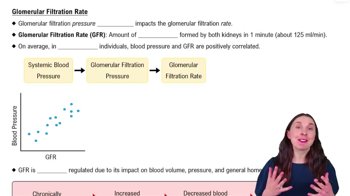
 3:15
3:15
 07:59
07:59 01:29
01:29Changing the luminal diameters of the afferent and efferent arterioles to alter the GFR can be an example of
(a) Hormonal regulation
(b) Autonomic regulation
(c) Autoregulation
(d) All of these
Name the segments of the nephron distal to the renal corpuscle, and state the functions of each.
What is the function of the juxtaglomerular complex?
What are the primary functions of the urinary system?
Trace the pathway of the protein-free filtrate from where it is produced in the renal corpuscle until it drains into the renal pelvis in the form of urine. (Use arrows to indicate the direction of flow.)
The distal convoluted tubule is an important site for
(a) Active secretion of ions
(b) Active secretion of acids and other materials
(c) Selective reabsorption of sodium ions from the tubular fluid
(d) All of these