
Textbook Question
The chemotherapeutic drugs Mr. White is taking affect all cells that undergo rapid mitosis, such as those of the skin. What effect would this have on the functions of the skin? How could this affect his immunity?
768
views

 Verified step by step guidance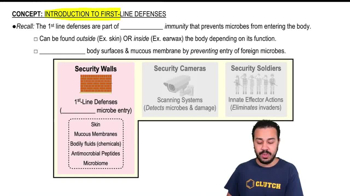
 1:56
1:56
 2:30
2:30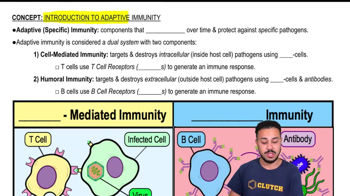 5:47
5:47The chemotherapeutic drugs Mr. White is taking affect all cells that undergo rapid mitosis, such as those of the skin. What effect would this have on the functions of the skin? How could this affect his immunity?
Which of the following does not describe the relationship between the lymphatic and immune systems?
a. Lymphoid organs and tissues house cells of the immune system.
b. Lymphoid organs and tissues trap pathogens for the immune system.
c. Lymphoid organs activate cells of the immune system.
d. Lymphoid organs and tissues create the surface barriers of the immune system.
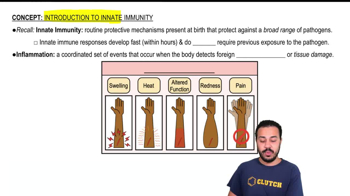
Nonspecific immunity is also known as_____. Specific immunity is also known as_____. Specific immunity has the capacity for immunological ______ .
Your friend tests her snake-wrangling skills on an eastern diamondback rattlesnake, and is bitten and envenomated (injected with the snake's venom). In the emergency department, doctors administer the antivenin CroFab, which contains antibodies to the toxins in snake venom. Is this an example of active or passive immunity? Will this confer any lasting protection to your friend?
Mark the following statements as true or false. If a statement is false, correct it to make a true statement.
Surface barriers contain substances in their secretions that kill pathogens and deter their growth.
Mark the following statements as true or false. If a statement is false, correct it to make a true statement.
Phagocytic cells of innate immunity include NK cells and basophils.