Ch. 6 Bones and Bone Structure
Martini - Fundamentals of Anatomy & Physiology 11th Edition
Martini, Nath, Bartholomew11th EditionFundamentals of Anatomy & PhysiologyISBN: 9780136874089Not the one you use?Change textbook
Chapter 6, Problem 10

The nonpathologic loss of bone that occurs with aging is called:
(a) Osteomyelitis
(b) Osteoporosis
(c) Osteopenia
(d) Osteitis
(e) Osteomalacia

Verified step by step guidance
1
Step 1: Understand the terminology related to bone conditions. Each option refers to a different bone-related condition with distinct causes and characteristics.
Step 2: Define each term briefly: Osteomyelitis is an infection of the bone; Osteoporosis is a condition characterized by decreased bone density leading to fragile bones; Osteopenia is a condition where bone mineral density is lower than normal but not low enough to be classified as osteoporosis; Osteitis refers to inflammation of the bone; Osteomalacia is the softening of bones due to defective bone mineralization, often caused by vitamin D deficiency.
Step 3: Identify the key phrase in the question: 'nonpathologic loss of bone that occurs with aging.' This means the bone loss is a normal part of aging, not caused by disease or infection.
Step 4: Compare the definitions to the key phrase. Osteopenia and osteoporosis both involve bone loss, but osteoporosis is a more severe pathological condition, while osteopenia is often considered a precursor or mild reduction in bone density.
Step 5: Conclude that the term describing the normal, nonpathologic bone loss with aging is osteopenia, as it reflects a decrease in bone density that is not necessarily disease-related.

Verified video answer for a similar problem:

This video solution was recommended by our tutors as helpful for the problem above.
Video duration:
3m
Was this helpful?

Key Concepts

Here are the essential concepts you must grasp in order to answer the question correctly.

Nonpathologic Bone Loss

Nonpathologic bone loss refers to the natural reduction in bone density and mass that occurs as part of the normal aging process, without being caused by disease or injury. It is a gradual decline that can affect bone strength but is distinct from pathological conditions.
Recommended video:

Osteopenia

Osteopenia is the condition characterized by lower than normal bone mineral density, representing an early stage of bone loss. It is considered a nonpathologic or mild reduction in bone mass that often precedes osteoporosis and is commonly associated with aging.

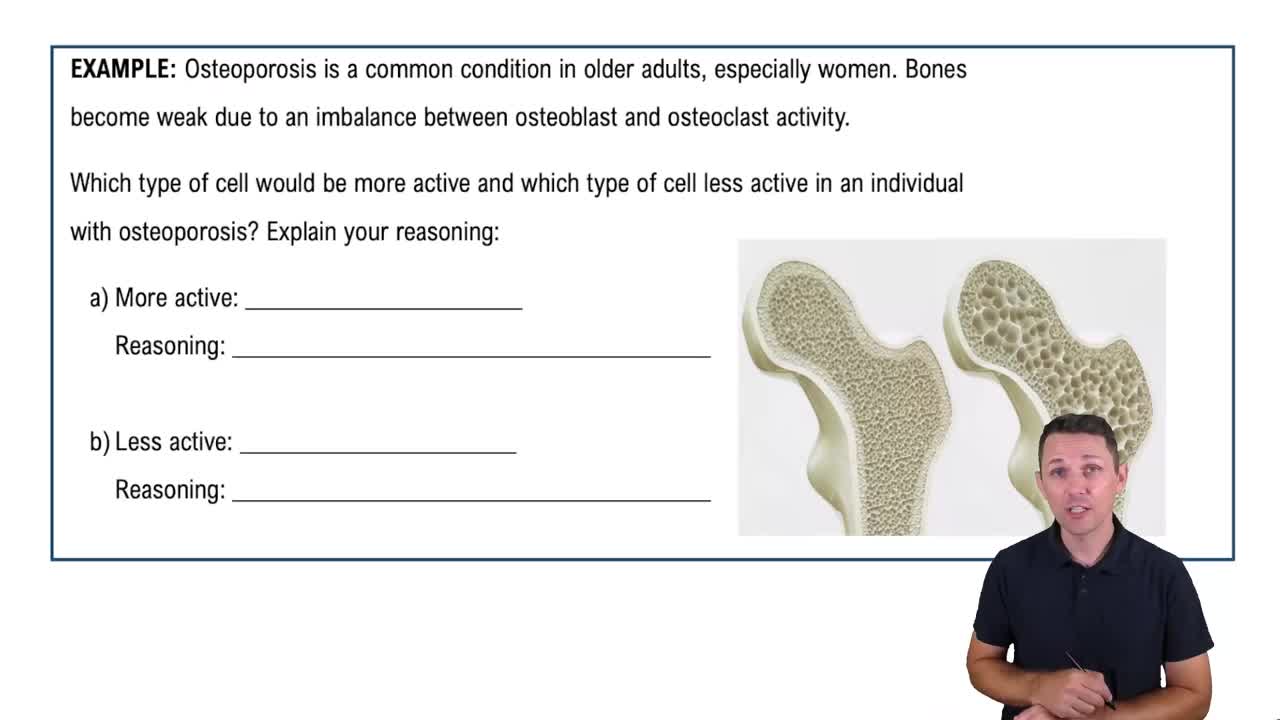
Osteoporosis

Osteoporosis is a pathological condition marked by significant bone loss and structural deterioration, leading to increased fracture risk. Unlike osteopenia, it is a disease state rather than a normal aging process, often requiring medical intervention.
Recommended video:
Guided course
1:57
Microscopic Anatomy of Bones - Bone Cells Example 2